The thing most festival packing lists forget isn't a phone charger. It's a plan for your body.
Heat and noise add up fast. So do dust and twelve hours on your feet. By Saturday afternoon, that's what fills the medical tent. This festival packing list is built the way a festival doctor would build it: health basics first, then gear, then the fun stuff. It works for a single-day pass and a four-night camping weekend, and every health tip links to the guidance behind it.
Pack from the top down. If you run out of room, cut from the bottom of the festival packing list, never the top.
The short version: what a festival doctor packs first
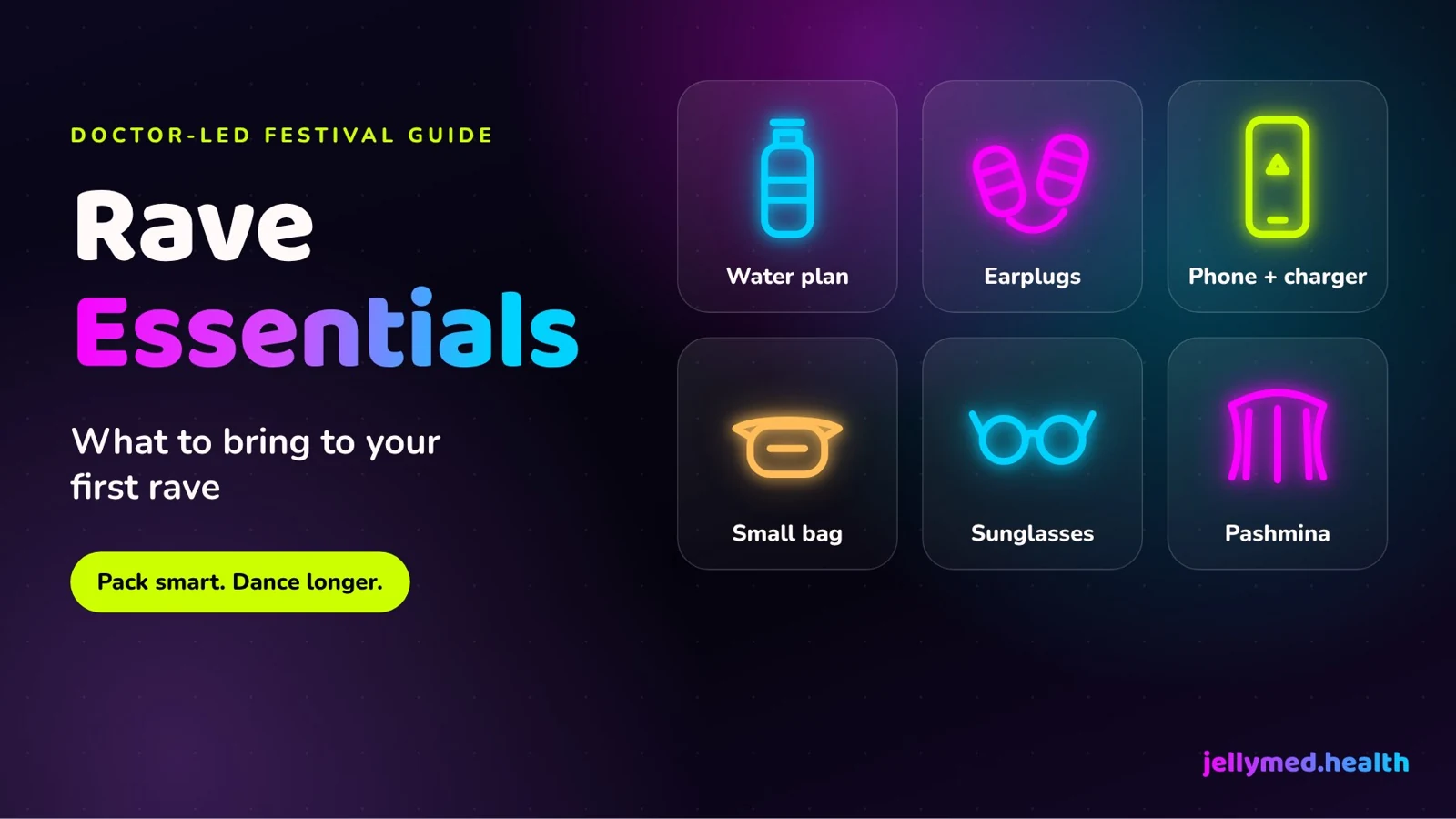
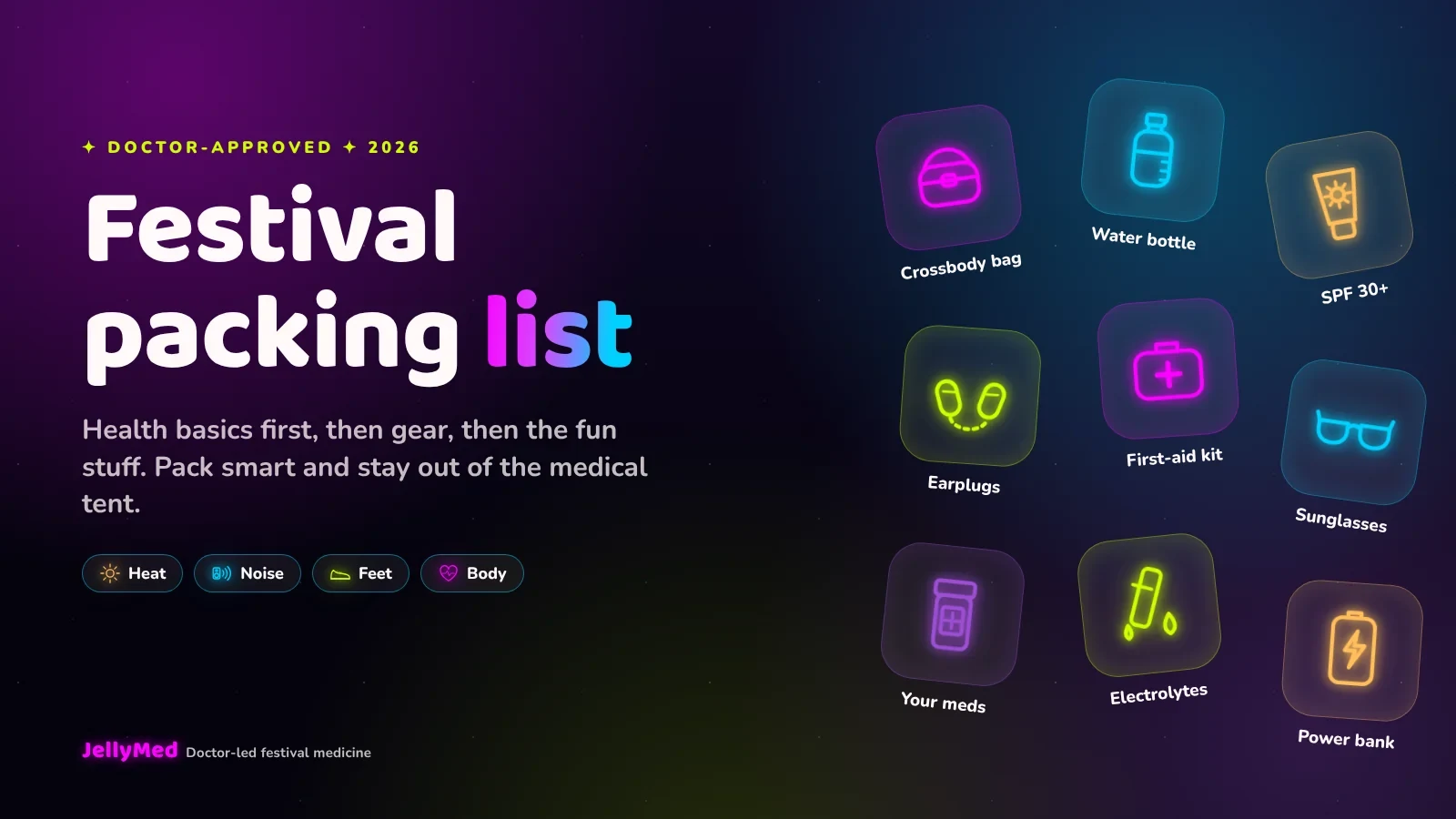
Short on time? These ten festival essentials do the most to keep you dancing and out of trouble. Everything else on this festival packing list is comfort.
- Refillable water bottle or hydration pack (check the festival's empty-bottle rule)
- Electrolyte powder sticks or tablets
- Sunscreen (SPF 30+, broad-spectrum, water-resistant) plus SPF lip balm
- Earplugs, ideally reusable high-fidelity ones
- Your meds in labeled pharmacy bottles, with a spare day's supply
- Mini first-aid kit with blister care
- Sunglasses and a sun hat
- Broken-in shoes, plus two pairs of moisture-wicking socks per day
- Portable charger and cable, because your phone is your map and your lifeline
- Hand sanitizer and wipes
Notice what isn't on it. No outfits, no tent, no speaker. Those matter, but they won't send you to the medical tent if you forget them.
Why a health-first festival packing list looks different
Most guides are written by gear brands. They're great on tents and outfits and thin on what actually goes wrong with people.
Here's what does go wrong. The sun is relentless at desert events like Coachella and EDC Las Vegas. The CDC notes that sunburn slows your skin's ability to release heat. So a burn isn't only a cosmetic problem; it makes overheating more likely. Crowds trap warm air. Lines for water get long, and people stop drinking when they're having fun.
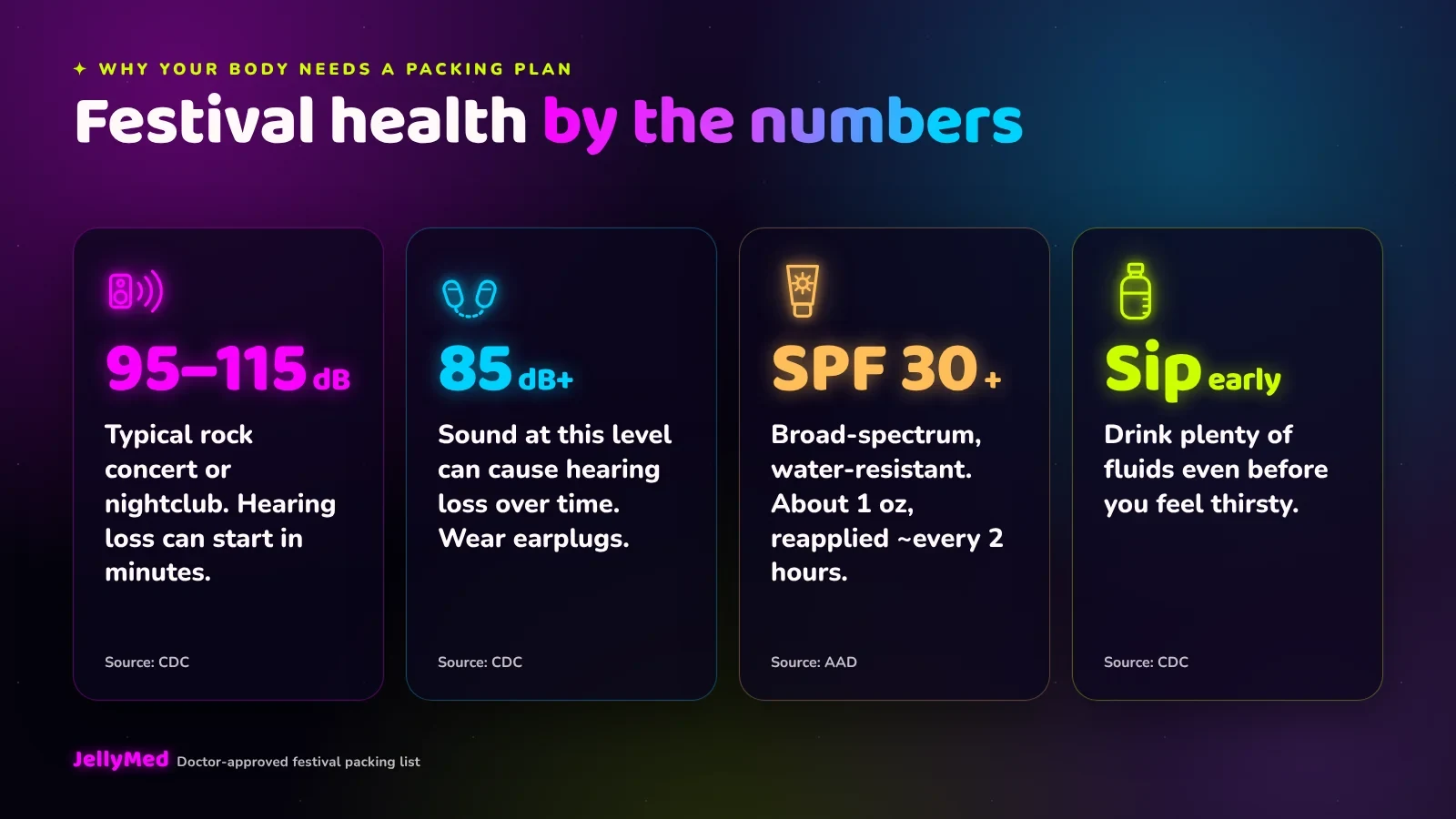
Then there's sound. According to the CDC, rock concerts and nightclubs run 95 to 115 decibels, and hearing loss can start after a few minutes at those levels. A music festival puts you in that range for hours, several days in a row.
Feet take a beating too. Big sites mean miles of walking on dirt, grass or pavement, often in new shoes.
None of this means you should stay home. It means ten dollars of the right gear, like earplugs and moleskin, does more for your weekend than a fourth outfit. That's the thinking behind every list below.
Your festival packing list should also match the event. A Coachella packing list leans hard on sun protection and cool-weather layers for desert nights. A humid Southern camping festival like Bonnaroo calls for quick-dry clothes and extra socks. Burning Man is built on radical self-reliance, so you bring every drop of water and every bandage you'll need. Read your festival's FAQ and the 10-day weather forecast before you finalize anything.
Festival essentials: ticket, ID, money and the right bag
Start with the boring stuff, because no one gets in without it.
- Ticket or wristband. Activate RFID wristbands before you travel. Screenshot any QR codes in case signal drops.
- Photo ID and your health insurance card (a photo of the back helps too).
- A card plus some cash. Many US festivals are cashless inside, but parking and campground vendors sometimes aren't.
- Phone and a power bank. A 10,000 mAh portable charger usually covers a full day of maps, photos and group texts. Put your phone on low-power mode the moment you arrive.
Now the bag. Check your festival's bag policy before you buy anything, because many American festivals limit bag size or require clear bags. Within those rules, a crossbody bag or fanny pack worn in front is the easiest to keep track of in a crowd. Pickpockets love a backpack.
A slim hydration pack is the best choice for hot afternoons if it's allowed. You'll drink more when the water is literally on your back.
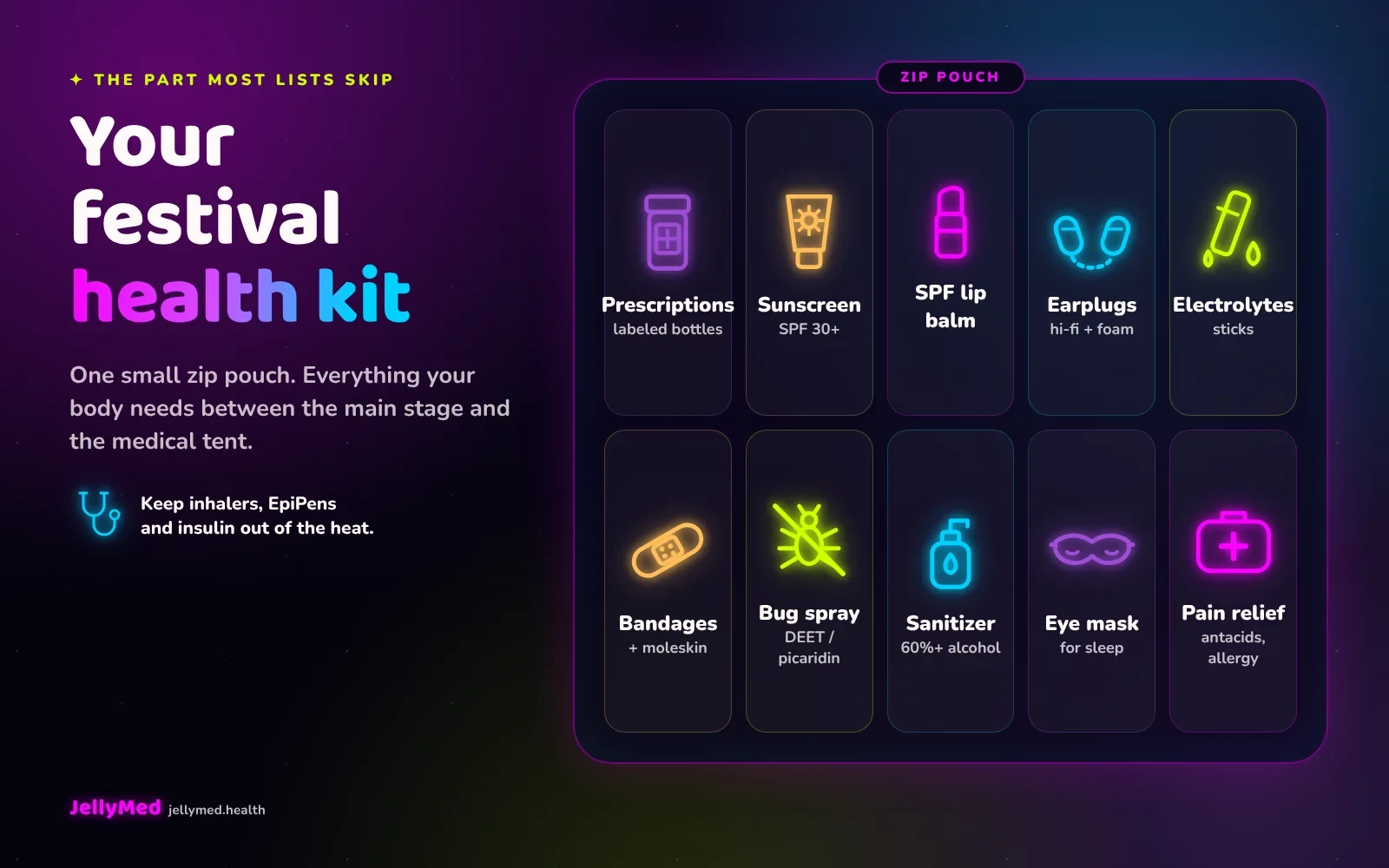
Keep your health basics in one small zip pouch inside that bag. When you need sunscreen or your inhaler at the main stage, you won't be digging.
Your festival health kit
This is the part most packing lists skip. It's also the part that decides whether you remember the headliner or the medical tent.
Prescriptions and everyday meds
Bring every medicine you take daily, plus at least one extra day's supply in case travel goes sideways. Keep them in their original labeled pharmacy bottles. That's what security usually expects to see, and it protects you if you're ever asked. Check your festival's FAQ for its medication policy before you go.
Daily meds like birth control and PrEP are easy to miss precisely because they're so routine. Set a phone alarm for your usual dose time. Festival days blur together.
Heat changes how some medicines behave. The CDC lists medications that raise the risk of heat illness, including diuretics, some antidepressants (SSRIs and tricyclics), ADHD stimulants and older antihistamines like diphenhydramine. If you take any of these, plan more shade breaks and more water, and ask your doctor before the trip.
Heat can also damage the medicine itself. The same CDC guidance notes that inhalers can burst in hot places. EpiPens may deliver less epinephrine after heat exposure, and insulin can lose strength. Never leave them in a parked car or a sun-baked tent. Carry them on you, or keep them in an insulated bag away from direct ice.
A mini first-aid kit that earns its space
You don't need a paramedic's bag. You need a small kit you'll actually carry:
- Bandages in a few sizes, plus moleskin or blister pads for the hot spots that show up on day two
- Antiseptic wipes
- Antibiotic ointment
- A pain reliever you already know agrees with your stomach, taken with food and water
- Antacids and an anti-diarrheal
- Non-drowsy allergy tablets
- Saline eye drops, because dust gets everywhere and contact lenses hate it
- Safety pins
Pack tampons, pads or a cup even if you don't expect your period. Travel and broken sleep can shift cycles. Add condoms too; nobody regrets having them.
Sunscreen, lip balm and bug spray
The American Academy of Dermatology recommends a broad-spectrum, water-resistant formula with SPF 30 or higher. Most adults need about one ounce, roughly a shot glass, to cover exposed skin. Reapply about every two hours or after sweating. At Coachella or any desert festival, that means the bottle lives in your day bag, not your tent.
Use an SPF lip balm too. Sun-blasted lips burn and crack, and sun can trigger cold sores if you get them.
For mosquitoes at evening sets or lakeside events, pick a repellent with an EPA-registered active ingredient like DEET, picaridin, IR3535 or oil of lemon eucalyptus. The CDC's rule is simple: sunscreen first, bug spray second.
Earplugs and an eye mask
Ear protection is the most underrated item on any festival checklist. The CDC advises wearing earplugs at concerts and moving away from speakers, since sound is far louder up close. Reusable high-fidelity plugs lower the volume without muffling the music. That matters, because people only keep in the ones that still sound good.
Ringing ears after a set is a warning. Not a badge. If it happens, give your ears a quiet stretch and stand farther from the stacks tomorrow.
Pack cheap foam earplugs and an eye mask for sleep, since campgrounds stay loud until dawn and rest is the first thing to go at a multi-day event.
Water, electrolytes and festival snacks
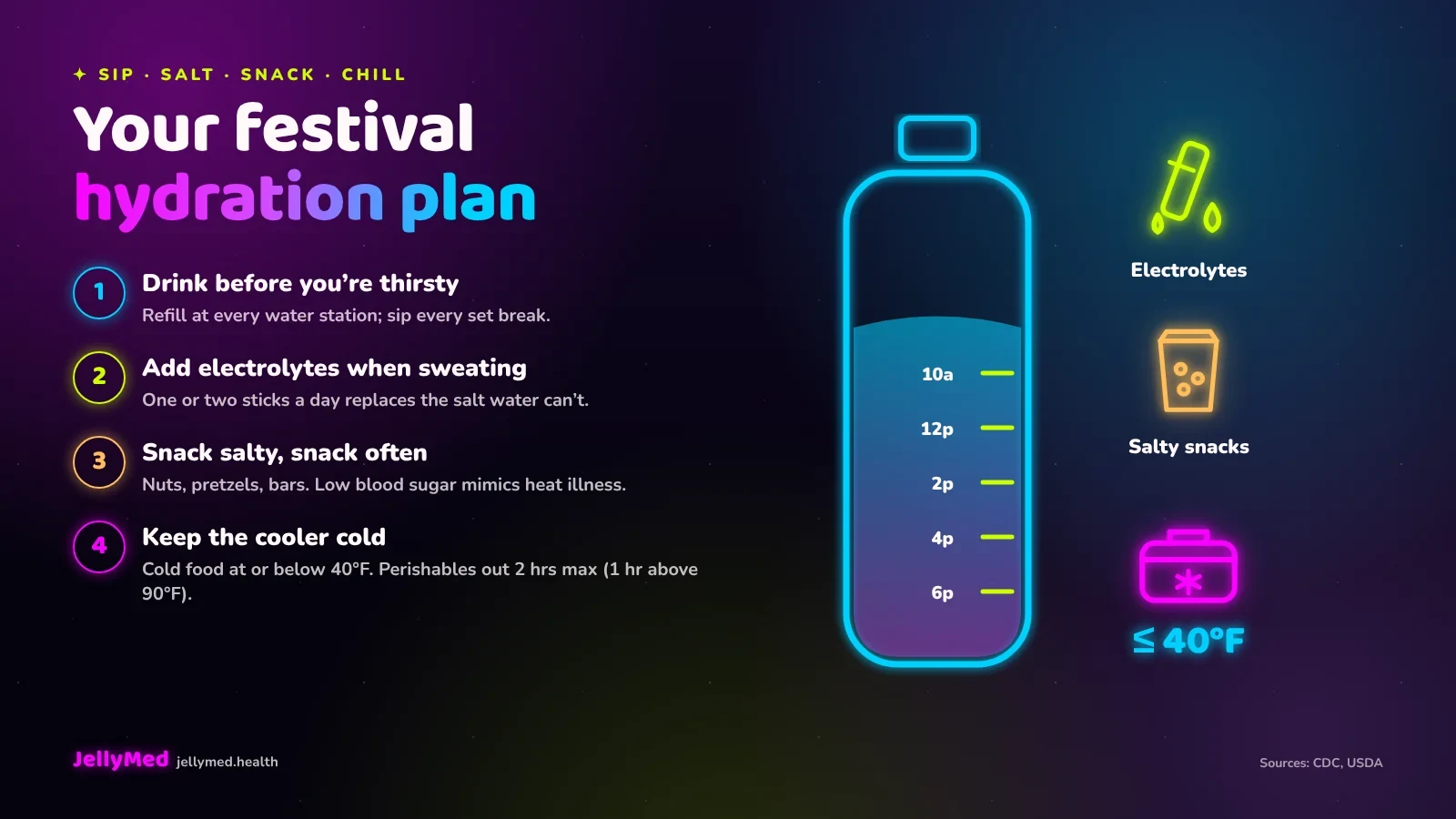
The CDC's advice for hot days is to drink plenty of fluids even if you don't feel thirsty. Thirst lags behind what your body needs, especially when you're excited, distracted or drinking alcohol.
A practical rhythm: refill your water bottle every time you pass a station, and sip every set break. If you're sweating a lot, add an electrolyte stick once or twice a day. Sweat carries salt out with it, and plain water doesn't put that back.
Pale-yellow urine is a decent sign you're keeping up. Dark urine, or barely going at all, means drink more and find shade.
Alcohol and many party substances make dehydration and overheating worse. If you're drinking, alternate each drink with a full cup of water.
Food matters more than people think. Low blood sugar plus heat feels a lot like heat exhaustion, and snacks are the most skipped line on any festival packing list. Pack easy snacks that survive a hot bag:
- Salted nuts, pretzels or trail mix (salt helps)
- Granola or protein bars
- Fruit pouches or dried fruit
- Nut-butter packets and crackers
Camping? Treat your cooler like a food-safety device. The USDA says to keep cold food at or below 40°F, and don't leave perishables out more than two hours (one hour above 90°F). Keep raw meat sealed at the bottom, and keep drinks in a separate cooler so the food lid stays shut. Food poisoning in a porta-potty line is nobody's highlight.
What to wear to a festival (and on your feet)
Style is yours. The clothing part of a festival packing list is where people go all-in on looks, so here's the medical side.
Dress in layers. Desert festivals like Coachella can be scorching at 3 p.m. and surprisingly cold after midnight. The CDC recommends loose, lightweight, light-colored clothing in the heat. Start with breathable clothing, then add a hoodie or light jacket for night. Layers you can tie around your waist beat one heavy coat. Check the weather forecast twice: a week out and the day before.
Cover up from the sun. A wide-brim sun hat and UV-blocking sunglasses do more than sunscreen alone. Bring a backup pair of sunglasses, because the first pair always gets sat on. A bandana is cheap and useful too. Wet it for cooling, or pull it over your nose when the dust kicks up.
Pack for rain anyway. A packable rain jacket or poncho weighs almost nothing. Wet clothes at night are how people get chilled, so keep one dry set of clothes sealed in a zip bag.
Feet first. Choose shoes you've already walked miles in. Brand-new boots are a blister factory. The AAD suggests moisture-wicking or nylon socks, well-fitting shoes and moleskin on hot spots. Change socks midday if your feet are sweaty, and if a blister forms, cover it rather than popping it.
Waterproof footwear is worth it for camping festivals where mud is likely, and a waterproof spray can rescue boots you already own. For a single day on grass, comfortable sneakers usually win.
Camping festival packing list
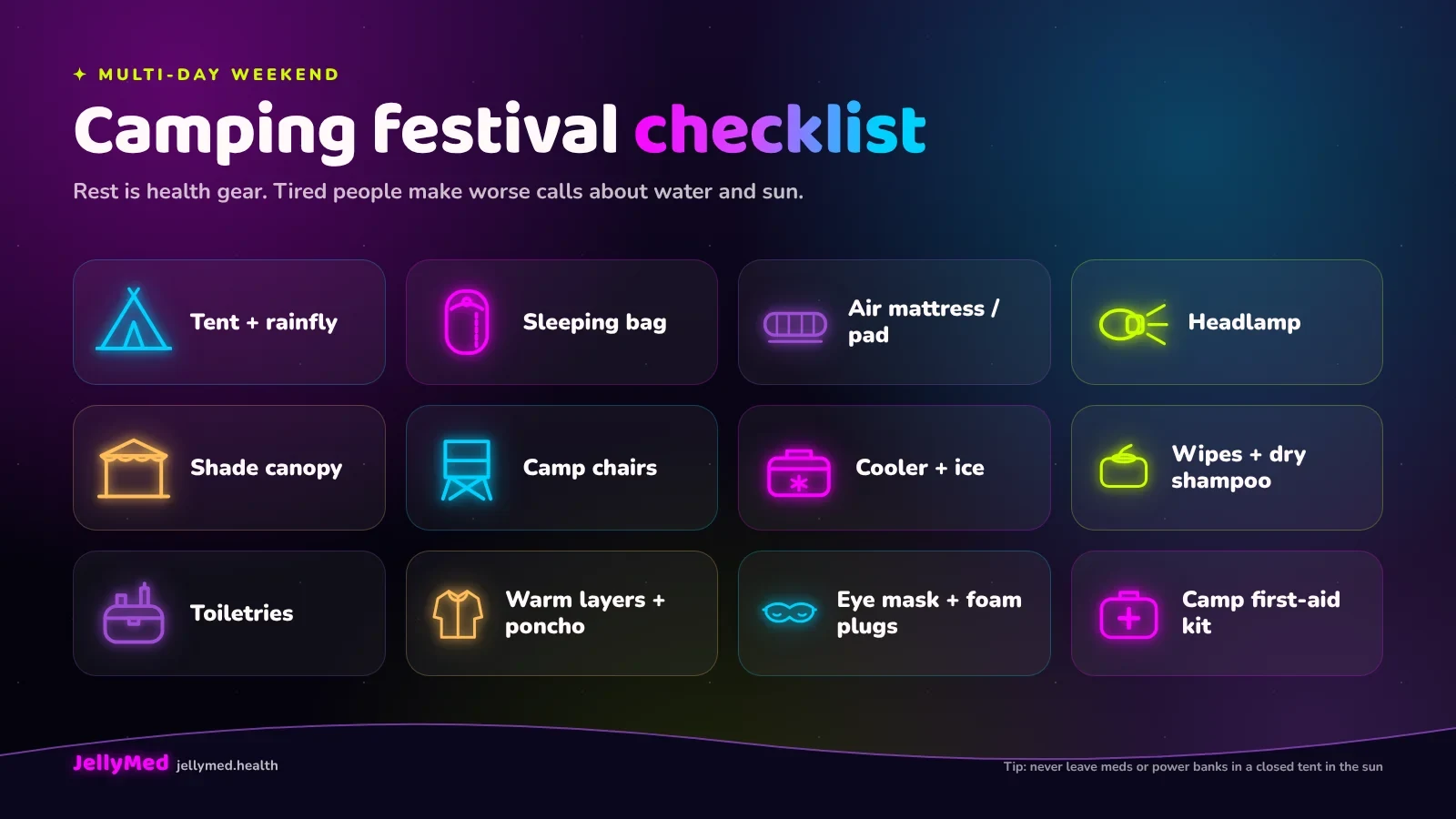
A camping festival adds a second job: staying rested for several days. Tired people make worse calls about water and sun.
Tent, sleep and shade
- Tent, stakes and rainfly. Pitch it once at home.
- Sleeping bag rated for the coldest night in the forecast.
- Sleeping pad or air mattress, plus the pump. Cold ground steals heat all night.
- Pillow. A real one buys you two more hours of sleep.
- Headlamp with fresh batteries.
- Shade canopy and camp chairs for a cool spot between sets.
- Duct tape. It fixes almost anything.
A tent turns into an oven by mid-morning, so don't plan to nap in it after 9 a.m. Rest under the canopy instead. Never leave medicines, your phone or a power bank inside a closed tent in direct sun.
Set up your campsite with health in mind. Pitch near (not next to) the water station and the porta-potties, mark your tent with a flag or string lights so you can find it at 2 a.m. and keep a gallon jug of water at camp for mornings. A small first aid kit at the campsite, separate from your day kit, saves a long walk.
Burning Man and other desert camping events add dust and extreme temperature swings. Goggles, a dust mask and extra water storage move from optional to essential there.
Toiletries and staying clean-ish
Showers at festival campsites range from decent to nonexistent. Pack toiletries for a few days without one:
- Biodegradable body wipes
- Dry shampoo (a small can is enough for a weekend)
- Toothbrush and toothpaste
- Deodorant
- Sanitizing gel with at least 60% alcohol
- A quick-dry towel
- Toilet paper (porta-potties run out)
One catch: the CDC notes that hand sanitizer works poorly on visibly dirty or greasy hands, which describes most hands at a camping festival. Wipe off the grime first, then sanitize. Before you eat, use a real handwashing station when you can find one.
Chafing is the quiet festival injury. A stick of anti-chafe balm or petroleum jelly on thighs and feet, applied in the morning, prevents a lot of misery by day three.
Day festival vs. camping weekend checklist
Not every festival packing list needs a tent. Here's what changes between a single day festival and a full camping weekend.
| Item | Day festival | Camping weekend |
|---|---|---|
| Water bottle or hydration pack | Yes | Yes, plus a gallon jug at camp |
| Electrolyte sticks | 1 to 2 | 1 to 2 per day |
| Sunscreen and SPF lip balm | Travel size | Full bottle plus travel size |
| Ear protection | High-fidelity pair | Plus a foam pair for sleep |
| Medications | Day's dose plus a spare | Full trip plus one extra day |
| First aid supplies | Pocket kit | Full kit at camp |
| Portable charger | One | One each, plus a solar panel |
| Shoes and socks | One pair, spare socks | Two pairs, socks for every day |
| Layers and rain gear | Light hoodie | Warm layers, poncho, sleep clothes |
| Tent, sleeping bag, pillow | No | Yes |
| Food | Snacks only | Cooler with real meals |
| Toiletries | Wipes and sanitizer | Full kit plus dry shampoo |
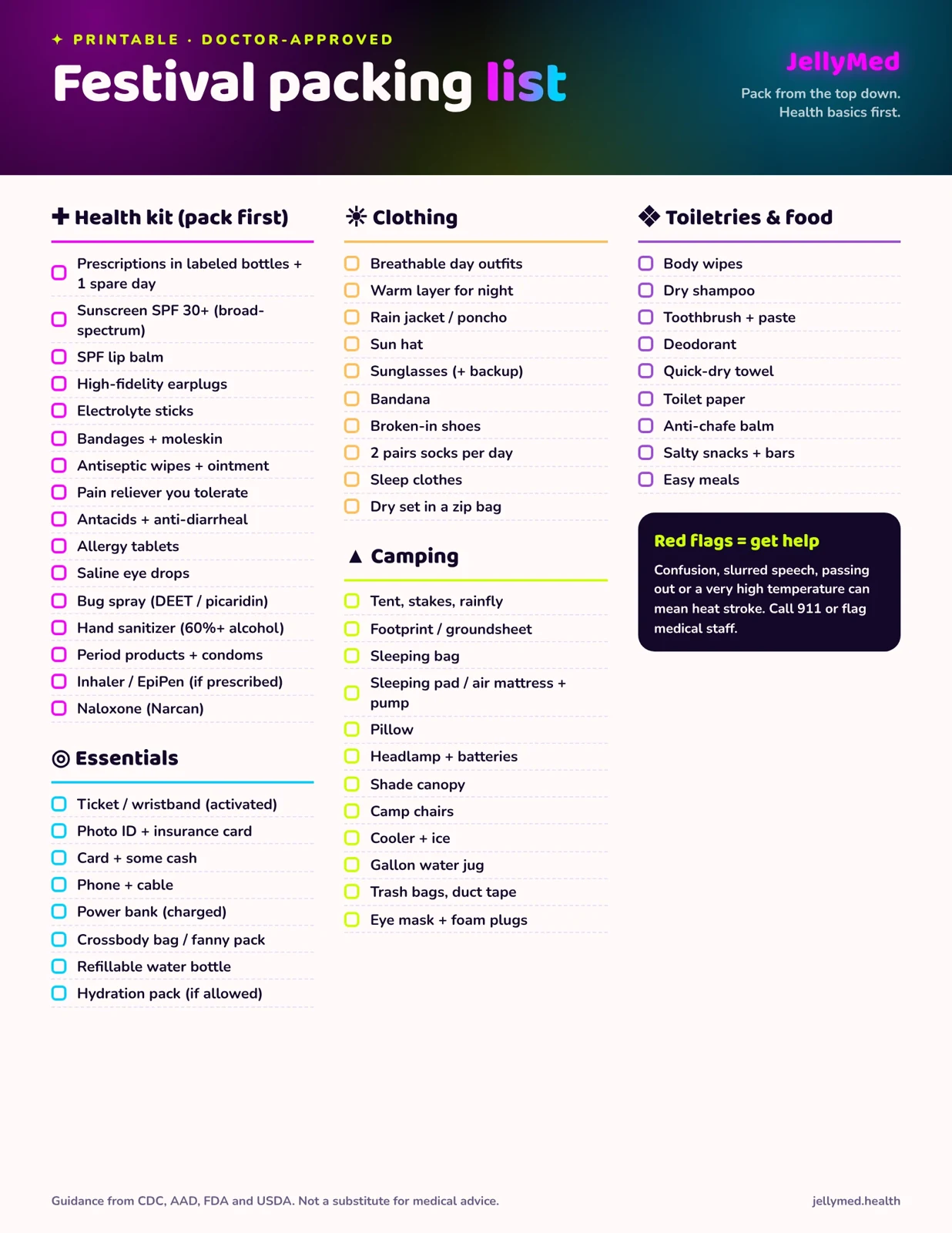
Want this on paper? Use the printable festival checklist below. Tick it off as you pack, then tape it inside your tent for the drive home.
Red flags: when to stop dancing and get help
Even a perfect festival packing list lowers your risk without removing it. Know these signs for yourself and your friends.
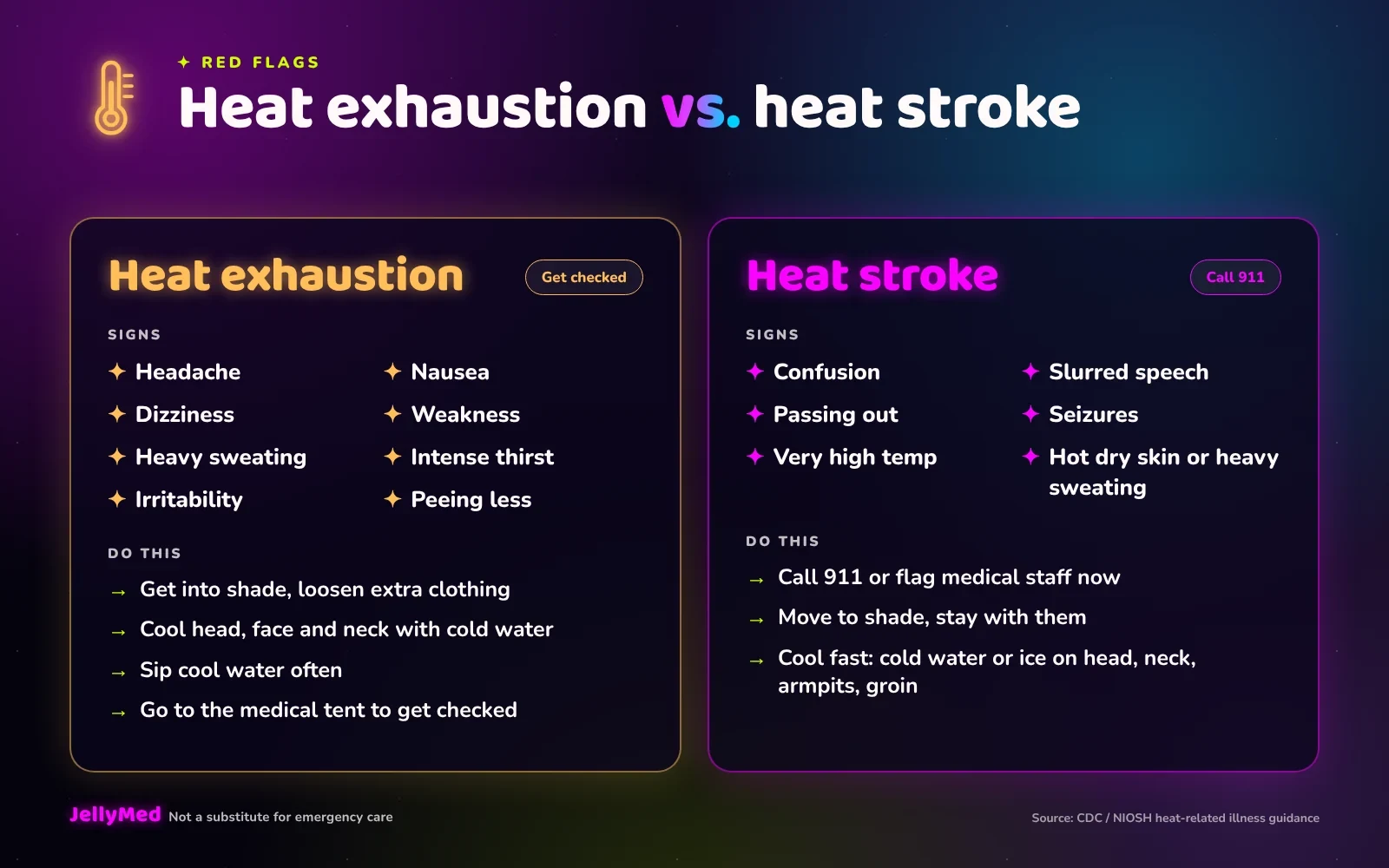
Heat exhaustion can look like a headache with nausea or dizziness. Weakness, irritability and heavy sweating are common, and so are intense thirst and peeing less than usual, according to the CDC. Get out of the sun, loosen or remove extra clothing, cool your head and neck with cold water and sip cool fluids. Then go to the medical tent to get checked.
Heat stroke is an emergency. Watch for confusion or slurred speech, passing out or a seizure, and a very high body temperature with either hot dry skin or heavy sweating. Call 911 or flag festival medical staff right away. Don't wait to see if heat stroke passes on its own. While you wait, move the person to shade and cool them fast with cold water or ice on the head, neck, armpits and groin. Stay with them.
Get help right away for chest pain, trouble breathing, a severe allergic reaction, or a friend who won't wake up. If you think someone has overdosed on opioids, call for help and use naloxone if you have it. The FDA approved Narcan nasal spray for over-the-counter sale in 2023, and it rapidly reverses an opioid overdose. Carrying it doesn't mean you're planning to need it; it means you can help someone else.
Not an emergency, but something feels off? A rash, a stomach that won't settle, a UTI, a migraine or a medication question can often be handled by a doctor online. That's exactly what JellyMed's doctor-led care is for, before, during and after the weekend. For anything on the red-flag list, go in person.
Your pre-festival week, step by step
Good packing starts a few days out, not the night before.
- Seven days out: read the festival's prohibited-items list and bag policy. Note the medication rules.
- Five days out: refill prescriptions and check expiry dates on your EpiPen or inhaler. If you have health questions about the trip, this is the moment to book a JellyMed visit, while there's still time to fill anything you need.
- Three days out: buy snacks and anything missing from the health pouch.
- Two days out: charge every battery you own. Camping? Pitch the tent and unroll the sleeping bag at home so nothing's missing when you arrive.
- The night before: pack the health pouch first, then work down this festival packing list. Check the weather forecast one more time.
- Morning of: eat a real breakfast and drink a big glass of water. Sunscreen goes on before you leave the house.
Get the body stuff right and the rest of the weekend gets a lot easier. The glow lasts longer when you're not fighting a sunburn and a blister at the same time.
Questions people ask about festival packing
What should I bring to a festival for the first time?
Start with the ten essentials at the top of this festival packing list. Water bottle, sunglasses and sunscreen, ear protection and your meds come first, then a small first aid kit and broken-in shoes. Add your ticket and ID. First-timers usually overpack outfits and underpack health basics, so flip that ratio and you'll be fine.
How do I pack light for a festival?
Pick one small crossbody bag or fanny pack and only carry what you'll use before you're back at camp or home. Decant lotion into a travel tube and wear your bulkiest layer instead of packing it. Leave anything you'd be upset to lose. Light bags also make security lines faster, which means more time at the music festival itself.
What kind of bag should I take to a festival?
Check the festival's bag policy first, since many US events limit size or require clear bags. Within the rules, a crossbody bag or fanny pack worn at the front is easiest to protect in crowds. A small hydration pack is ideal at hot day festivals, because it keeps water on you and makes you more likely to drink regularly.
What should be in a festival first aid kit?
Keep it small enough to carry. Bandages and moleskin handle feet. Antiseptic wipes and antibiotic ointment handle scrapes. Add a pain reliever you tolerate, antacids, an anti-diarrheal, allergy tablets and saline eye drops, plus period products and condoms. Keep prescription bottles separate, and always carry an EpiPen or inhaler if you've been prescribed one.
How much water should I drink at a festival?
There's no single number. It depends on the heat and your body, and on how much you're sweating. The CDC's guidance is to drink plenty of fluids even before you feel thirsty. In practice, refill at every station and add electrolytes on hot days. Pale-yellow urine is a good sign. Dark urine means drink more and rest in shade.
Can I bring my prescription medication into a festival?
Usually yes, but rules vary by event, so check the festival's FAQ before you go. Bring medicines in their original labeled pharmacy bottles with your name on them, and pack only what you need plus a spare day. Put them at the very top of your festival packing list. Keep inhalers and insulin out of direct heat. If you're unsure, a doctor can help you plan.