You know the feeling. The encore ends, the house lights come up, and on the walk to the car everything sounds like it's wrapped in cotton. Then the ringing starts.
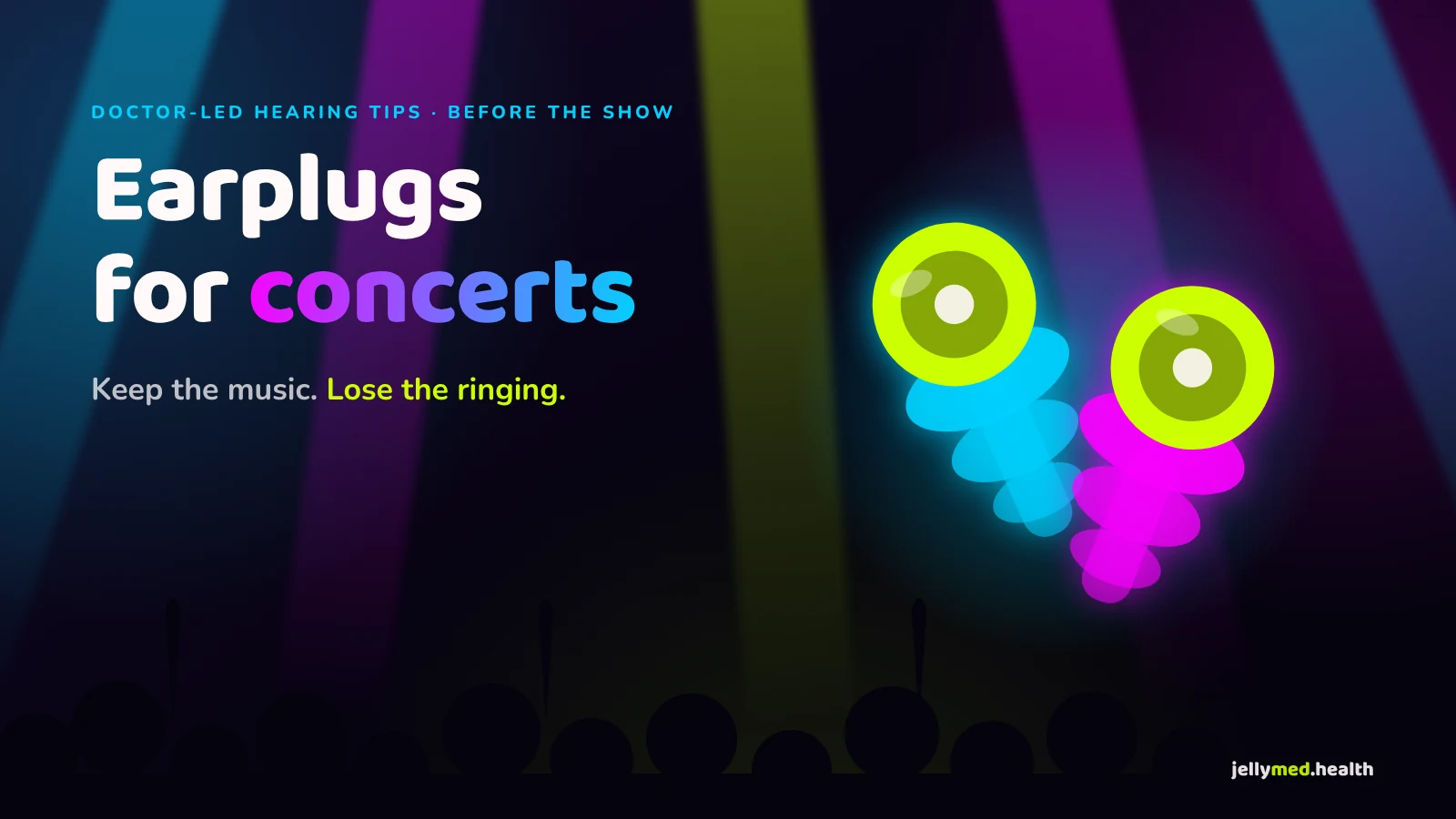
That ringing is your ears telling you they took a hit. The good news is that a $20 pair of earplugs for concerts is simple hearing protection that can prevent most of it, and the right pair won't make the show sound worse. Good concert earplugs turn the volume down evenly, so you still hear the vocals, the bass line and the crowd. You just stop paying for it the next morning.
This guide covers why shows damage hearing, what the research says about earplugs, which type to buy, how to wear them so they actually seal, and when ringing after a show means you should talk to a doctor.
Why your ears ring after a show
Deep inside your inner ear sit thousands of tiny sensory hair cells. They turn sound vibrations into signals your brain reads as music. Sound that's too loud can damage the tiny bundles on top of each cell, so the signal stops getting through. According to the NIDCD's Noisy Planet campaign, damaged hair cells in humans can't be repaired or replaced, which is why noise-induced hearing loss is permanent.
After a loud night, many people get a temporary threshold shift. Quiet sounds are harder to hear for a few hours or a day, and then hearing seems to bounce back. Ringing in the ears, called tinnitus, often comes with it. For most people that tinnitus fades by the next afternoon. For some, after years of loud nights, it never fully leaves.
Here's the catch. "Seems to bounce back" isn't the same as "no damage." Each temporary shift is a sign the hair cells were pushed past their limit, and the damage adds up over years of shows, festivals and loud bars. Most people don't notice hearing loss until it's already there: conversations in restaurants get harder, and the TV creeps louder. The upside is that noise-induced hearing loss is preventable, which is exactly why hearing protection at shows is worth the small effort.
How loud is a concert, really?
Loudness is measured in decibels (dB), and the decibel scale is logarithmic. Every 3 dB jump doubles the sound energy hitting your ears. So 100 dB isn't a little louder than 85 dB. It's roughly 30 times the energy.
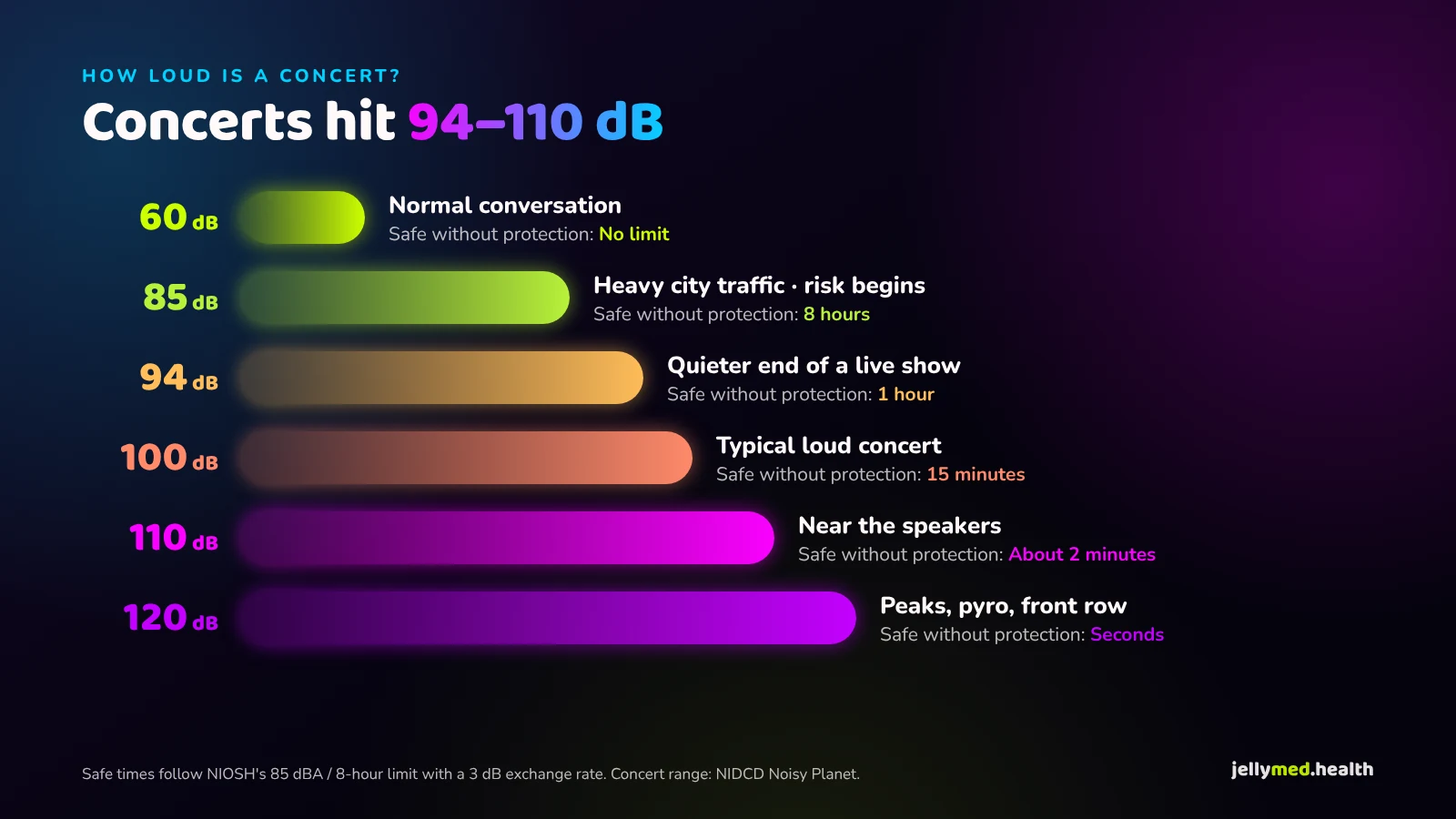
NIOSH sets its safe limit for workers at 85 dBA averaged over eight hours. Every 3 dB above that halves it:
| Sound level | NIOSH occupational exposure limit | What that means at a show |
|---|---|---|
| 85 dBA | 8 hours | The level where hearing risk begins |
| 91 dBA | 2 hours | About one full headline set |
| 94 dBA | 1 hour | The quieter end of live music, like a small acoustic room |
| 97 dBA | 30 minutes | Shorter than an opener |
| 100 dBA | 15 minutes | Three or four songs, unprotected |
| 110 dBA | About 1–2 minutes | Standing near the speakers |
Concerts and sporting events usually run between 94 and 110 dBA and can spike to 140 dBA, according to NIDCD. At 110 dBA, damage can start in about two minutes. A two-hour headline set at 100 dB is eight times the daily "safe dose" before the encore even starts.
Do earplugs for concerts actually work?
Yes, and there's solid evidence behind it.
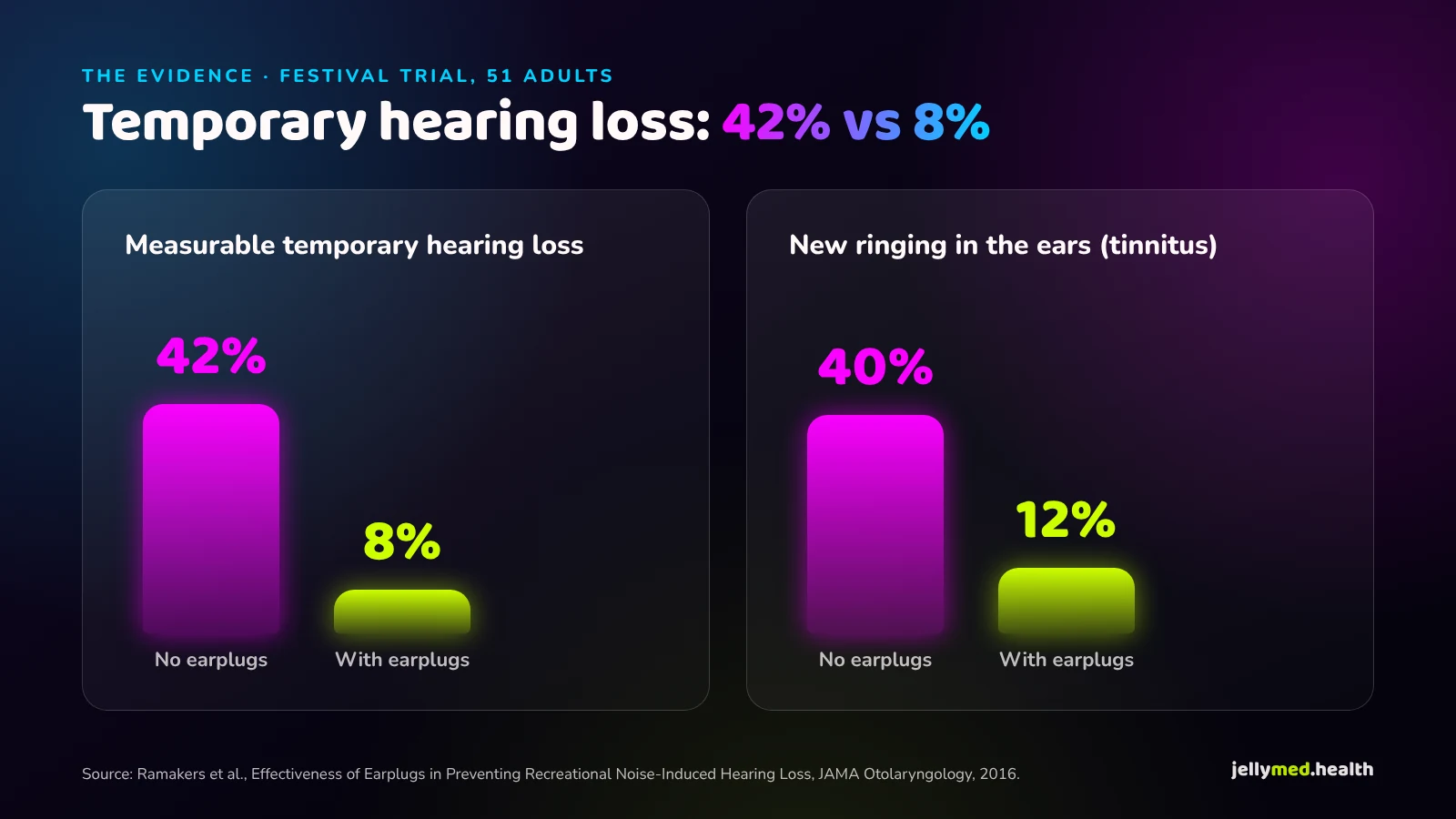
In a 2016 randomized clinical trial published in JAMA Otolaryngology, researchers in the Netherlands sent 51 adults with normal hearing to an outdoor music festival in Amsterdam. About half got earplugs. The rest didn't. After the festival, 42% of the unprotected group had a measurable hearing drop, compared with 8% of the earplug group. New ringing showed up in 40% of people without earplugs and 12% of those wearing them.
That's a big difference from something that fits in a coin pocket. And remember, this was one day of live music. Most of us go to many shows a year, and the tinnitus risk stacks with each one.
Yet hardly anyone uses them. A 2018 CDC survey found only about 8% of American adults routinely wear hearing protection at loud sporting and entertainment events, and almost 82% said they never or seldom do. Ask around at your next live music night and you'll see it. If you wear earplugs for concerts, you're ahead of most of the crowd, and you'll likely still be enjoying shows long after they've started saying "what?" a lot.
Concert earplugs vs. regular foam earplugs
All earplugs lower the volume. The difference is how they lower it, and that's what decides whether the show still sounds good.
NIOSH notes that flat-attenuation earplugs reduce sound more evenly across frequencies, which can help music sound clearer. Fit still matters: a music-friendly design only protects you when worn correctly.
| Type | Typical noise reduction | Sound quality | Cost | Best for |
|---|---|---|---|---|
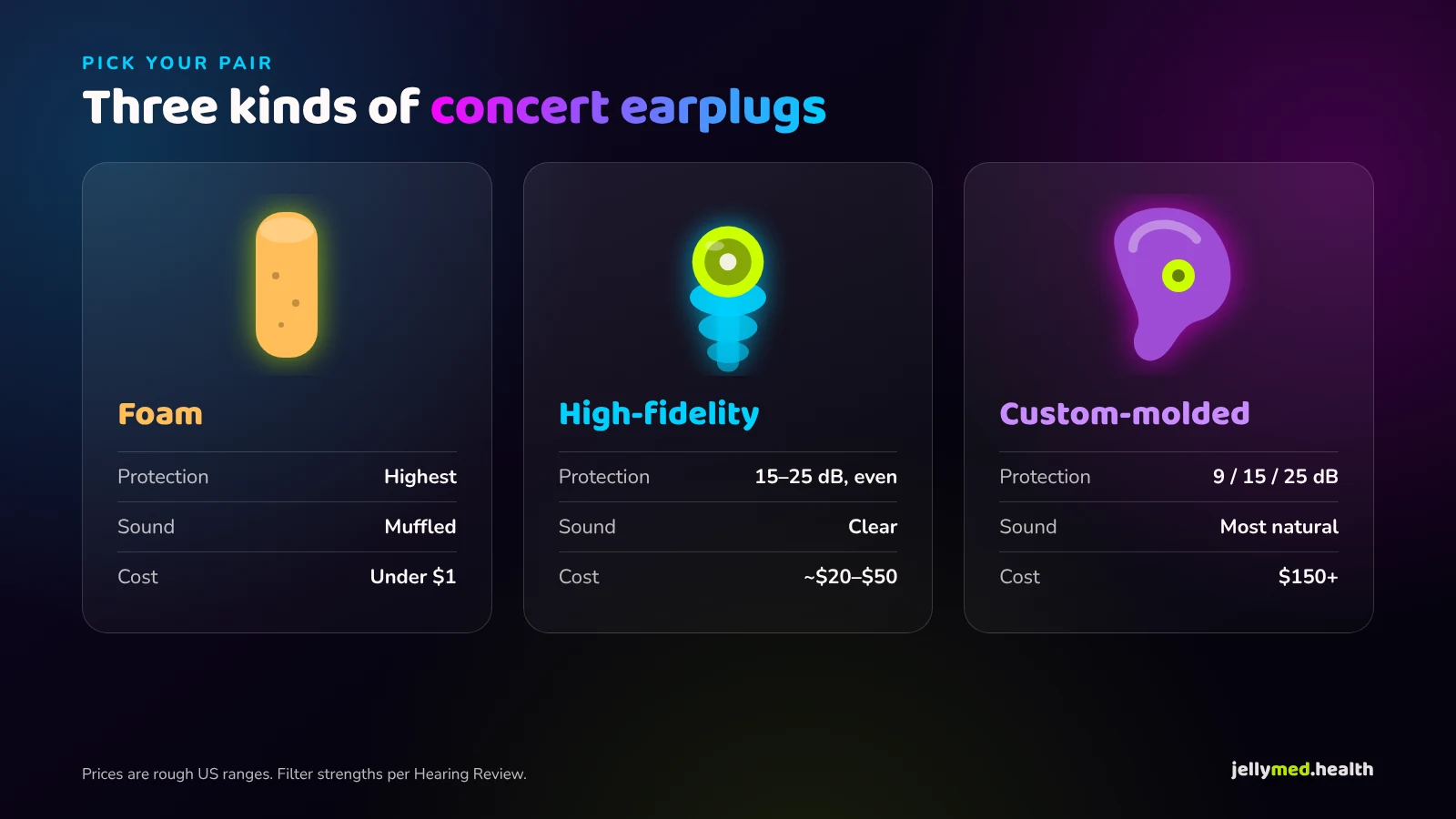
| Foam (disposable) | High, often NRR 29–33 | Muffled, bass-heavy | Under $1 a pair | Backup pair, very loud shows, tight budgets |
| High-fidelity / musician earplugs | Moderate, about 15–25 dB, fairly even | Clear, natural | About $20–$50 | Most concertgoers and festival weekends |
| Custom-molded with filters | Choice of 9, 15 or 25 dB filters | Most natural, best seal | Usually $150+ | Regular gig-goers, musicians, crew |
Prices are rough US ranges and vary by brand and retailer.
Foam earplugs
These squishy disposable plugs are cheap, everywhere and surprisingly protective when you fit them right. Many people under-insert them, though, and lose a lot of that protection. Their weak spot at live music is sound quality. Cymbals and vocals get dull while the bass still thumps through your chest. Keep a few pairs in your bag anyway. They're the best spare you can own.
High-fidelity (musician) earplugs
These are what most people mean by concert earplugs. They're usually made of soft silicone with flanged ear tips and small acoustic filters in the stem. You still hear the guitar tone and every word of the chorus, just quieter, and you can talk to your friends without shouting. Most come with two to four sizes of ear tips and a small carry case, and they last for months if you clean them.
Musicians have used this style for decades to protect their hearing on stage without losing the mix, and it's the same sound quality trick that works in the crowd. For most people heading to a show this weekend, it's the pair we'd buy.
Custom-molded earplugs
An audiologist takes an impression of your ear canal and a lab builds plugs shaped to you. You pick a filter strength, commonly 9, 15 or 25 dB (the ER-15 filter gives about 15 dB of fairly flat attenuation). They cost more and take a week or two to arrive, but they offer the best comfort for long sets and they last for years. Touring musicians and sound engineers tend to swear by them. Silicone custom molds usually seal more reliably than off-the-shelf plugs, too. If you're at shows every month, play in a band or work festivals, they pay for themselves, and an audiologist can check your hearing at the same appointment.
How many decibels of protection do you need?
Less than you'd think. The goal isn't silence. It's getting the sound reaching your eardrum down to a level you can enjoy for the whole set.
A fit test can measure your personal noise reduction. Without one, do not subtract the package rating from the venue level and assume the result is safe. Keep your plugs in, step away from speakers and take quiet breaks.
For most concerts, 15 to 25 dB of even noise reduction is the sweet spot. Go much higher and you lose clarity. People then pull their plugs out halfway through the set. A plug that sits in your pocket protects nothing.
What the NRR on the box really means
The NRR (Noise Reduction Rating) on the package is a laboratory rating, not your guaranteed protection. Subtracting 7 dB does not account for your individual fit. NIOSH recommends fit testing to measure your personal attenuation; a poor seal can greatly reduce protection.
Many high-fidelity earplugs list a modest NRR, sometimes in the low teens, and that's fine. Their whole design is about even attenuation across frequencies, not the biggest noise reduction number. Some brands also publish a full attenuation chart by frequency, which tells you far more than one figure. If your favorite band plays brutally loud, choose a pair with stronger filters, or wear foam and accept a darker tone.
How to choose the best earplugs for concerts
Forget the brand debate for a minute. The best earplugs for concerts are the ones you'll keep in for three hours. That comes down to a few things.
Fit comes first. If a plug doesn't seal, noise leaks around it and the protection drops fast. Look for packs that include ear tips in several sizes (XS to L). Smaller ear canals are common, and many people need a different size in each ear. A good fit should feel snug and secure, never like it's pushing on your eardrum.
Comfort decides whether you keep them in. Soft silicone tips usually feel better over a long night than hard plastic. Try them at home for an hour first, while you cook or watch a show. A plug that aches at minute 40 won't make it to the headliner.
Comfort is also personal. Some people love soft hybrid tips, others find triple-flange tips the most comfortable, and plenty need a smaller size than they expect. Don't assume the bestseller will suit your ears. Good protection you can't stand wearing is worth less than modest protection with all-night comfort.
Filters set the sound. Flatter filters keep music natural. Some sets come with swappable filters, so you can go lighter at an acoustic show and heavier at a metal gig or an EDM main stage. If you only buy one pair, pick filters in the middle of the range.
Low profile matters if you care about looks. Many high-fidelity concert earplugs sit almost flush in the ear, which also helps comfort if you wear a hat or hood. Others are styled to be seen, in clear silicone or bright colors. Either way, you'll forget you're wearing them once the lights go down.
Little extras save the night. A keychain case means you'll actually have them on you. A neck cord helps at festivals, where lost earplugs are a weekend tradition. Spare tips are handy too, since they're the part that wears out first.
A quick buying checklist
- Reusable, soft silicone or foam-hybrid ear tips in at least three sizes
- About 15–25 dB of fairly even noise reduction for most shows
- Comfort you've tested for at least an hour at home
- A carry case that clips to your keys or bag
- Easy to clean
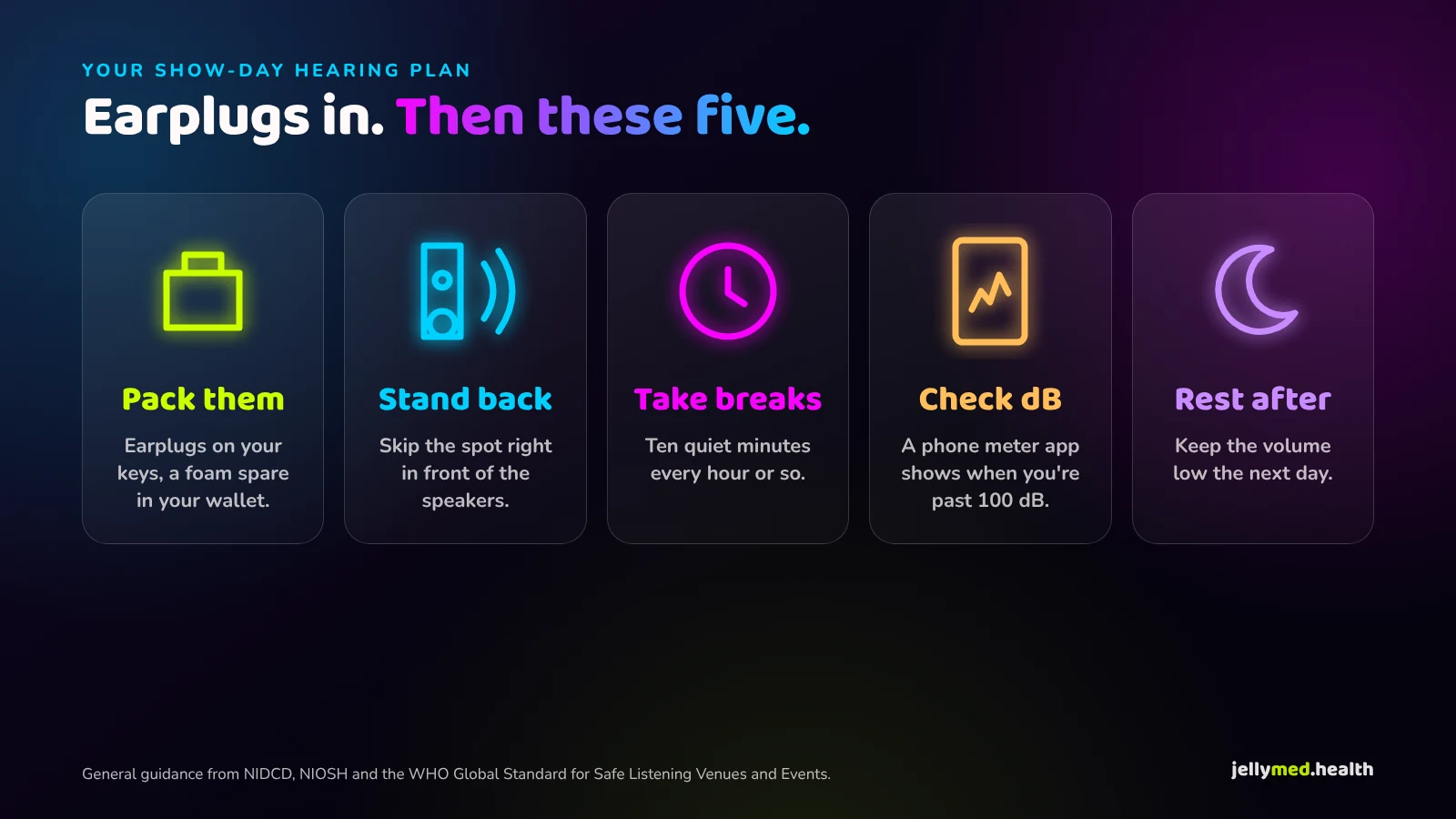
- A spare pair of foam plugs in your wallet, just in case
How to put earplugs in the right way
This is where most protection gets lost. A loose plug can give you a fraction of its rated noise reduction.
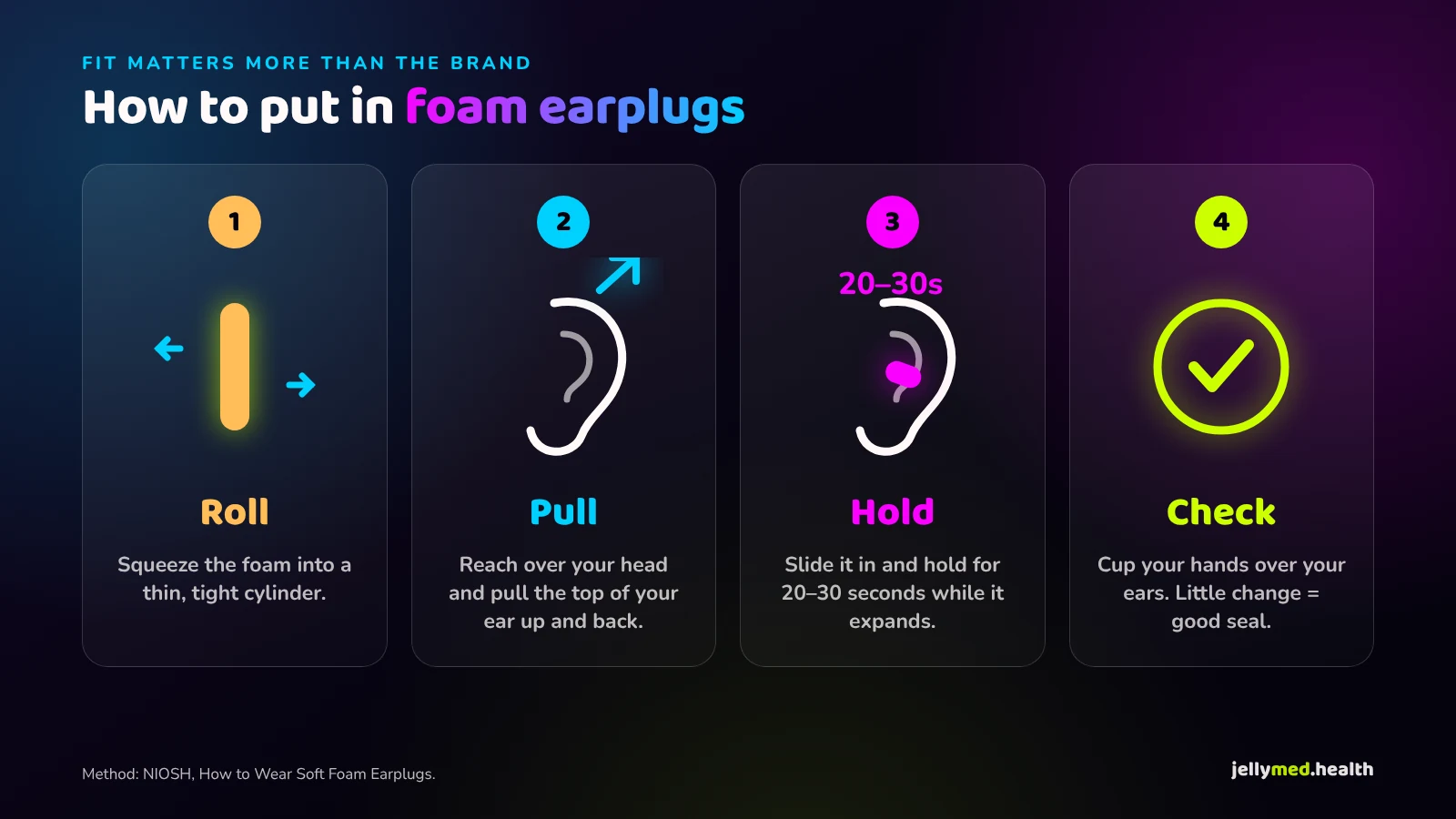
For foam earplugs, NIOSH teaches a simple roll, pull and hold method:
- Roll. With clean hands, squeeze the foam into a thin, tight cylinder.
- Pull. Reach over your head with the opposite hand and pull the top of your ear up and back. This straightens the ear canal.
- Hold. Slide the plug in and hold it with your fingertip while it expands to fill the canal (count to 20 or 30).
- Check. Most of the foam should be inside your ear canal. Cup your hands over your ears. If the sound doesn't change much, the seal is good. If it gets much quieter, take the plug out and try again.
For flanged high-fidelity plugs, the pull-up-and-back trick still helps. Push gently while twisting slightly until the ear tips seal and the fit feels secure. Your own voice should sound a little boomy, which is normal and means the seal is working.
Put them in before the opening act. It's much easier in the parking lot than in a packed pit, and the first band can be just as loud as the headliner.
More ways to protect your hearing at shows
Earplugs do the heavy lifting, but a few habits make a real difference on top of them. Think of it as layered hearing protection for live music.
Pick your spot. Volume drops off as you move away from the source. Right in front of the speakers is the worst spot for your ears. The sound desk in the middle of the floor is often the best-sounding spot in the room anyway.
Take ear breaks. Step out to the bar, the merch line or a quiet zone every hour or so. Ten quiet minutes helps comfort and gives tinnitus-prone ears a rest. The WHO Global Standard for Safe Listening Venues and Events asks organizers to cap average levels at 100 dB over 15 minutes, provide quiet zones and offer hearing protection to the crowd. Use those spaces when you find them.
Measure it. Free sound level meter apps on your phone (including the NIOSH SLM app on iPhone) give you a rough reading. If it says 100 dB, you know you're on the 15-minute clock without protection.
Watch the drinks. Alcohol can dull the discomfort that normally tells you a room is too loud, so you stay closer to the noise for longer.
Give your ears a quiet day after. Skip the earbuds on the drive home and keep the volume low the next day. Ears that just took a temporary threshold shift need recovery time.
Bringing kids or teens to a concert
Kids' ear canals are small, and many adult plugs won't fit or stay in. For young children, over-ear earmuffs made for kids are the safer pick. They're easy to put on, hard to lose and won't become a choking hazard. Teens can usually wear small-size earplugs with XS ear tips. Make putting them in part of the ticket deal, and wear yours too, because kids copy what they see. The WHO estimates that over one billion young people worldwide are at risk of hearing loss from loud recreational sound, and good habits start early.
Ears still ringing the next day? When to see a doctor
Tinnitus or muffled hearing that fades within a day is common after a loud show. It's still a warning sign, but it isn't usually an emergency. Treat it as a nudge to upgrade your hearing protection before the next ticket.
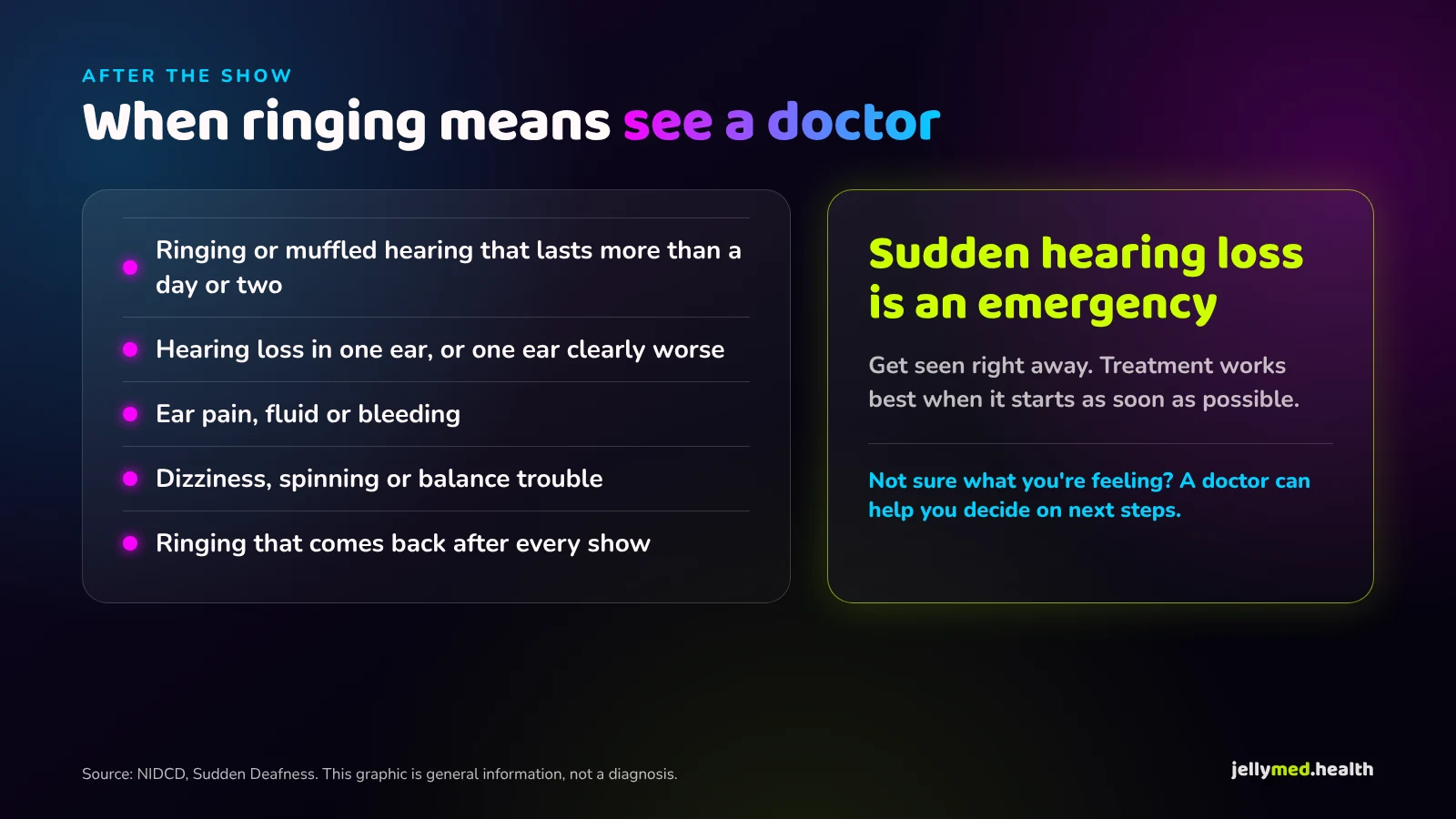
Get checked if you notice any of these:
- Ringing or muffled hearing that lasts more than a day or two
- Hearing loss in one ear, or one ear that feels clearly worse
- Ear pain, fluid or bleeding from the ear
- Dizziness, spinning or trouble with balance
- Ringing that comes back after every show
Sudden hearing loss is a medical emergency. The NIDCD advises seeing a doctor immediately if you lose hearing quickly, especially in one ear. Treatment with corticosteroids works best when it starts as soon as possible, and delays of more than two to four weeks make it less likely to help. Don't wait it out over the weekend.
If you're unsure whether what you're feeling is normal post-show ringing or something more, a JellyMed doctor can talk it through with you by telehealth, judgment-free, and tell you if you need an in-person hearing test or urgent care. Book a JellyMed visit .
Questions people ask about earplugs for concerts
What earplugs should I use for concerts?
For most people, high-fidelity earplugs with filters that lower volume by about 15 to 25 dB are the best choice. They protect your hearing while keeping music clear enough to enjoy. Disposable plugs block more noise but muffle the music. Custom-molded plugs from an audiologist are worth it if you go to shows often or are one of the many musicians who play live.
Is it good to wear earplugs at a concert?
Yes. Concerts often reach 100 dB or more, which can start damaging hearing in about 15 minutes, so some form of hearing protection is a smart default. In a randomized trial at a music festival, only 8% of earplug wearers had temporary hearing loss afterward, compared with 42% of people who went without. Earplugs also cut new tinnitus by more than two-thirds in that study.
Are concert earplugs different than regular earplugs?
Yes. Regular foam earplugs block high frequencies more than low ones, so music sounds dull and muffled. Concert or musician earplugs use acoustic filters to reduce sound more evenly across frequencies. You hear the same mix, just quieter, and it's easier to talk with friends between songs. Most use soft silicone ear tips for a comfortable seal.
Are foam earplugs OK for concerts?
Disposable earplugs offer strong protection when they're rolled, inserted deeply and held while they expand. They're a good backup and a solid choice for very loud shows. The downside is sound quality, because vocals and cymbals lose their sparkle while the low end rumbles on. If foam is all you have, wear it. Any properly fitted earplug beats no protection.
How many dB should earplugs block for a concert?
Choose protection that fits well and is appropriate for the sound level. The package NRR does not tell you how much protection you personally get; fit testing does. At very loud shows, move farther from speakers and take quiet breaks as well as wearing protection.
Can you still hear the music with earplugs in?
Yes, especially with high-fidelity concert earplugs. Many people find the show sounds cleaner, because the harsh edge of an overloaded room is turned down. Sound quality through good filters is close to the real mix, and plenty of musicians wear them for exactly that reason. Your own voice may sound a bit louder inside your head at first. That's normal and fades within minutes.
How long do reusable concert earplugs last?
Silicone concert earplugs typically last several months to a year with regular use, depending on how often you wear them and how you care for them. Wash them with mild soap and water, let them dry fully and store them in their pouch. Replace the ear tips when they harden, crack or stop giving you a good fit.
Before your next show: pack a pair of earplugs for concerts next to your ticket, stand back from the stacks and take a quiet break each hour. Your future self, still enjoying live music at 60, will thank you. If your ears don't feel right afterward, talk to a JellyMed doctor.