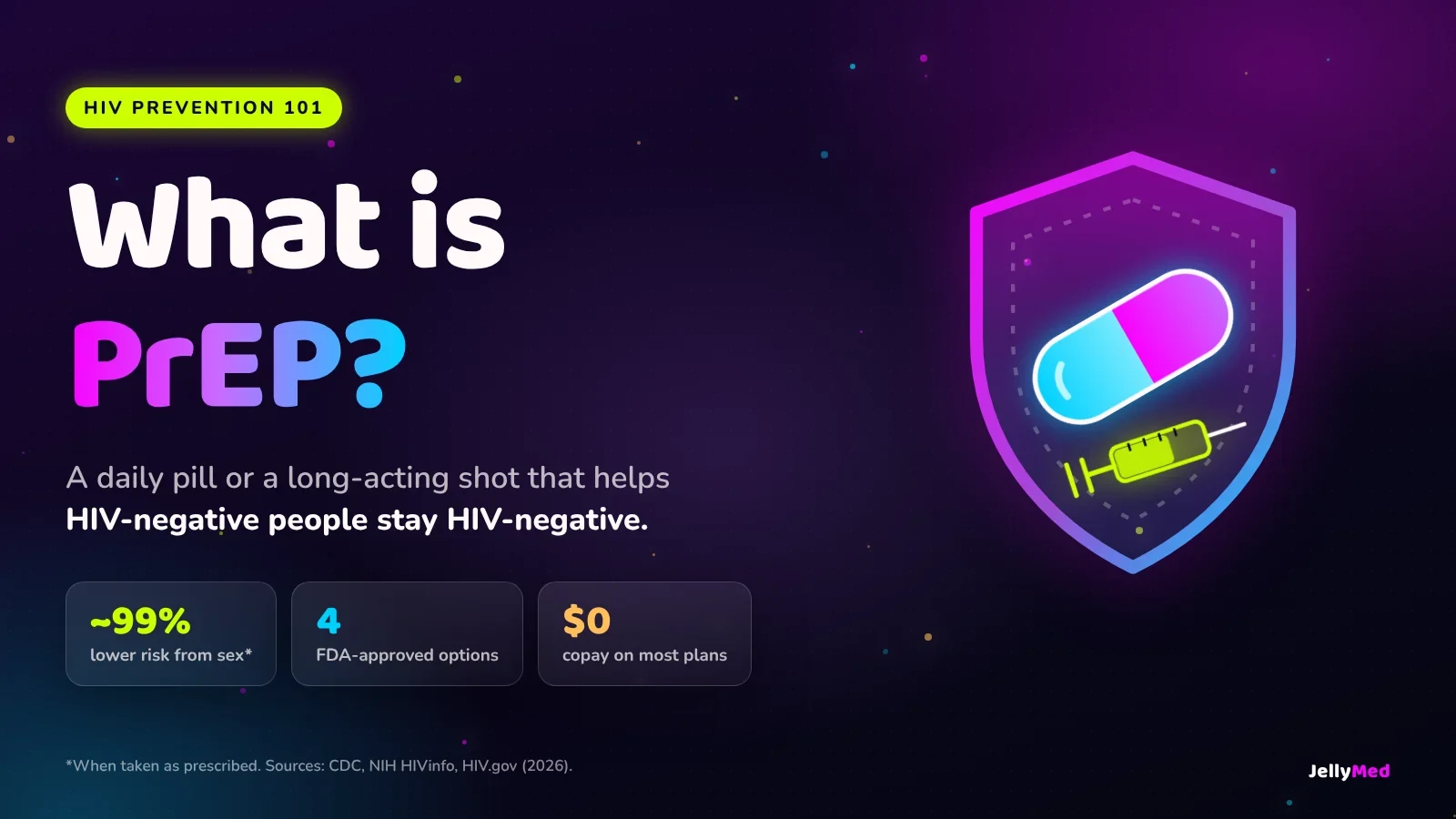
You can protect yourself from HIV before you're ever exposed. One daily pill, or a shot every two or six months, can lower your chance of getting HIV from sex by about 99% when you take it as prescribed. That's PrEP.
So what is PrEP, and is it right for you? Below: how it works, your four options, real side effects, cost and the exact steps to start. No lectures. No judgment. Just the facts you need to decide.
What is PrEP, in plain English?
PrEP stands for pre-exposure prophylaxis. "Prophylaxis" is a medical word for prevention, and "pre-exposure" means you start the medicine before any contact with the virus.
It's for people who are HIV-negative and want to stay that way. You take HIV medicine ahead of time so that if the virus gets into your body through sex or shared needles, it can't set up a lasting infection.
PrEP comes as an oral tablet or a long-acting injection. The first PrEP pill was approved by the FDA in 2012, and the CDC estimates that 2.2 million Americans could benefit from it. Far fewer actually use it.
That gap is the reason this page exists.
PrEP vs. PEP: what's the difference?
People mix these up constantly. PrEP is taken before a possible exposure, on an ongoing basis. PEP, or post-exposure prophylaxis, is emergency prophylaxis you start after a possible exposure.
PEP has to begin within 72 hours, and you take it for 28 days, according to MedlinePlus. Exposed in the last 72 hours? Stop reading and get PEP now. You can talk about PrEP once you've finished it.
How does PrEP work?
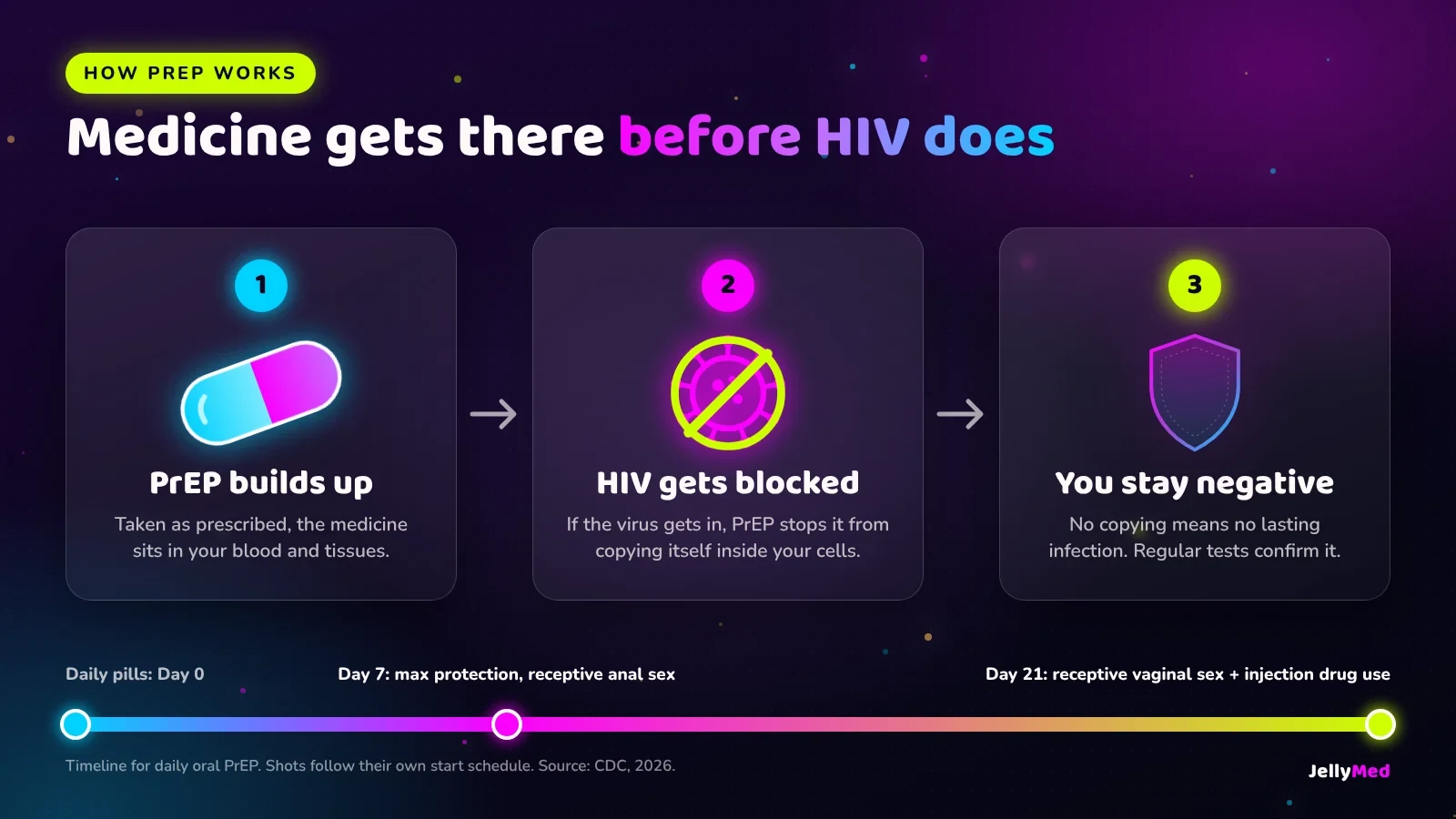
Pre-exposure prophylaxis works by getting there first. HIV needs to copy itself inside your immune cells to take hold. The medicine in PrEP sits in your bloodstream and tissues and blocks that copying step early. If the virus can't multiply, it can't build a permanent infection.
There's one catch: protection isn't instant. The CDC says daily PrEP pills reach maximum protection after about 7 days for receptive anal sex and about 21 days for receptive vaginal sex and injection drug use. Injections work on their own timeline, and some start with a few days of tablets.
PrEP isn't HIV treatment. Treatment keeps the viral load low in someone who already has HIV; PrEP keeps someone without HIV from getting it.
Types of PrEP available in the US
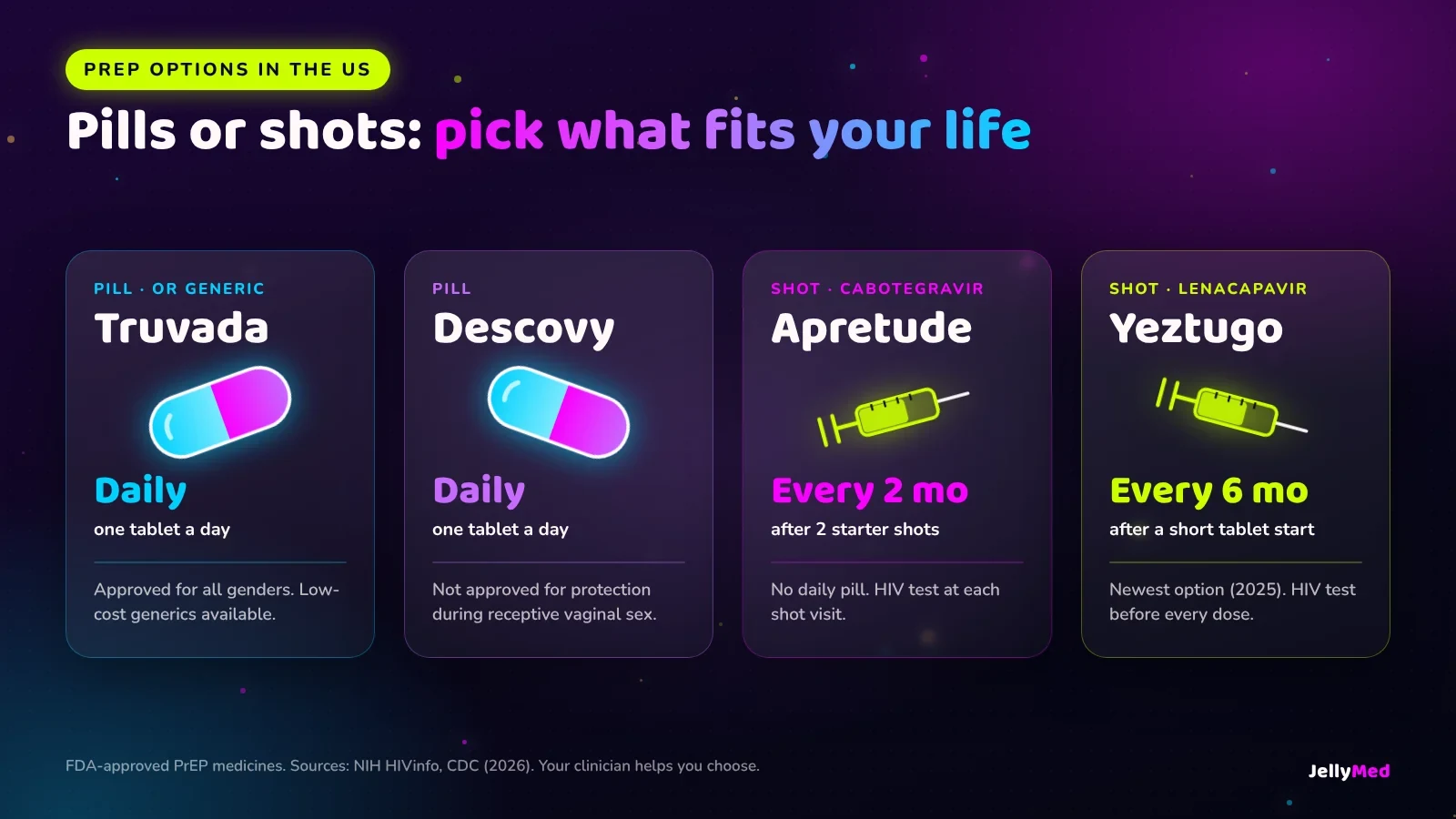
You've got four FDA-approved choices for pre-exposure prophylaxis. Two are pills and two are injections.
| Option | What it is | How often | Good to know |
|---|---|---|---|
| Truvada (or generic) | Emtricitabine + tenofovir disoproxil tablet | Once a day | Low-cost generics; approved for all genders |
| Descovy | Emtricitabine + tenofovir alafenamide tablet | Once a day | Not approved for people exposed through receptive vaginal sex |
| Apretude | Cabotegravir injection | Two starter shots a month apart, then every 2 months | Nothing to remember day to day |
| Yeztugo | Lenacapavir injection under the skin | Every 6 months, after a short tablet start | Newest HIV PrEP option, approved in 2025 |
Which one fits? If you're good with routines, PrEP pills are simple and well studied. If a daily habit sounds like a fight you'll lose, an injection takes that off your plate.
Yeztugo's trial results show how effective long-acting PrEP can be. In one study of cisgender women, none of the 2,134 people on it got HIV, and in a second study 99.9% stayed HIV-negative.
What about on-demand (2-1-1) PrEP?
You may have heard of on-demand PrEP. On the 2-1-1 schedule you take two pills 2 to 24 hours before sex, one pill 24 hours later and one more 24 hours after that.
Evidence supports the 2-1-1 schedule for gay and bisexual men having anal sex. It isn't FDA-approved, and the CDC doesn't recommend it, so only use on-demand PrEP if your health care provider has set it up with you.
How effective is PrEP?
Very effective. Taken as prescribed, PrEP lowers the risk of getting HIV from sex by about 99%, which makes it one of the most effective HIV prevention tools we have. For injection drug use, oral PrEP cuts the risk by at least 74%, per the NIH.
No prophylaxis is perfect, and the weak spot is missed doses. Protection against HIV drops when pills are skipped for days at a time.
PrEP does not protect against other sexually transmitted infections like gonorrhea, chlamydia or syphilis. It doesn't prevent pregnancy either. Condoms still matter for STIs, and you'll get tested for them regularly while you're on PrEP.
Who should consider PrEP?
Short answer: anyone who wants to lower their HIV risk. Current CDC clinical guidance tells clinicians to prescribe PrEP to anyone who asks, even if they don't report specific risk factors.
Consider it if any of these fit:
- You have sex without a condom with partners whose HIV status you don't know, or with several partners.
- Your partner has HIV and their virus isn't fully controlled yet.
- You've had a recent sexually transmitted infection or needed emergency HIV medicine more than once.
- You inject drugs or share needles or other equipment.
PrEP isn't only for gay men. Straight women and men, trans and nonbinary people, and teens who weigh at least 35 kg (77 lb) can all use it, as long as they're HIV-negative. Pregnancy doesn't rule out HIV prevention either.
PrEP side effects and safety
Most people feel nothing at all. Some feel a little off for the first few weeks, then it fades.
Common side effects
With PrEP pills, the usual list is nausea, diarrhea, headache and tiredness. The NIH also mentions dizziness and trouble sleeping. These side effects are typically mild and short-lived.
With PrEP shots, expect soreness, swelling or a small lump where the injection went in, plus the odd headache. Talk to your health care provider if side effects last more than a few weeks.
Rare but serious risks
Rarely, tenofovir-based tablets like Truvada and Descovy can strain the kidneys, which is why your health care provider checks kidney function before you start and from time to time after. Kidney failure and lactic acidosis are very rare but serious.
The bigger safety issue is starting PrEP when you already have HIV you don't know about. That can cause drug resistance and make future HIV treatment harder. It's the reason you'll always be tested for HIV before starting and before each refill or injection.
How to start PrEP, step by step
It's easier than most people expect.
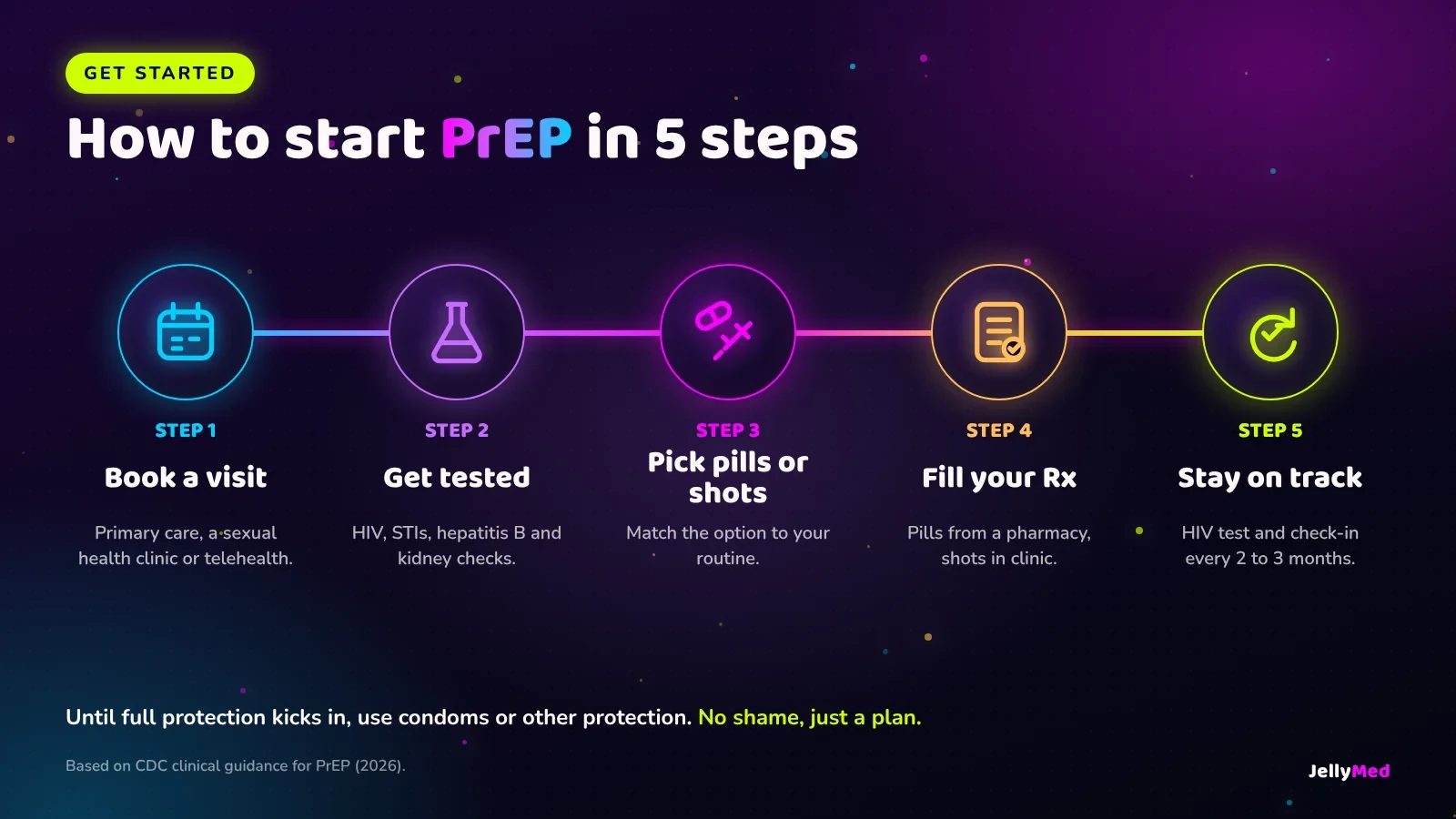
- Book a visit. Any health care provider can prescribe HIV PrEP: a primary care doctor, sexual health clinic or telehealth service. You don't need a specialist.
- Get your baseline tests. Expect an HIV test, screening for sexually transmitted infections, plus hepatitis B and kidney checks if you choose tablets. Your health care provider may also ask about pregnancy.
- Pick pills or shots. Talk through your routine, your partners and your budget, and choose the option that fits your life.
- Fill the prescription. PrEP pills come from a pharmacy, usually up to a 90-day supply. Shots are given by your health care provider.
- Protect yourself while it builds. Use condoms or other protection until you reach full protection, 7 to 21 days in for pills.
What follow-up visits look like
On pills, plan on a check-in at least every 3 months. Your health care provider repeats the HIV test, screens for other infections and renews your prescription. With Apretude, you get tested at each shot visit every 2 months. Yeztugo requires a negative result before every 6-month dose.
Is PrEP taken for life?
No. You take PrEP during the seasons of life when you want protection, and you can stop when that changes, like starting a monogamous relationship. Talk with your health care provider first, because how you stop depends on which medicine you're on and your current risk.
How much does PrEP cost?
Many health plans cover PrEP and required preventive services without cost sharing. Coverage can depend on your plan, network and medication, so verify those details before a visit. HIV.gov explains coverage and assistance options.
If you're on Medicaid, your state program covers PrEP too, and so does Medicare. If you don't have insurance, drug-company assistance programs, state PrEP assistance programs and groups like the Patient Advocate Foundation can lower the cost or cover it completely. HIV.gov keeps an updated list.
At JellyMed, a telehealth visit is a flat $45 for a licensed clinician review. Medicine, labs and pharmacy costs are separate, and a prescription is never automatic.
When to get care right away
Don't wait for a routine visit if:
- You had a possible HIV exposure in the last 72 hours. Ask for HIV PEP today.
- You get flu-like symptoms such as fever, rash or sore throat while on PrEP or soon after stopping. That can be a sign of acute HIV and needs a test.
- You notice signs of a serious reaction, like trouble breathing or swelling of the face. Call 911.
Questions people ask about PrEP
What is the downside of PrEP?
The main downside of PrEP is the routine. You need HIV testing and follow-up on the schedule for your medicine, and daily pills need consistent use. Skipping tests also risks drug resistance if HIV slips through. PrEP doesn't block other STIs, so condoms still have a role.
Is PrEP for straight people too?
Yes. PrEP works for anyone who could be exposed to HIV through sex or needles, whatever their sexual orientation or gender. Cisgender women can use Truvada or the PrEP shots. Descovy is the one option not approved for protection during receptive vaginal sex.
When should PrEP be taken?
Daily pills are best taken at the same time every day, with or without food. Start well before you need protection, since full protection from tablets takes about 7 to 21 days depending on the type of exposure. Shots follow a set clinic schedule.
Does PrEP protect against other STIs?
No. PrEP only prevents HIV. It won't stop gonorrhea, chlamydia, syphilis or herpes. That's why regular STI testing is part of every PrEP plan, and why condoms are still worth using. Ask your clinician about doxyPEP too if bacterial infections keep coming up.
Can I take PrEP while pregnant or breastfeeding?
Often, yes. The CDC considers the Truvada-type pill generally safe during pregnancy and breastfeeding, and staying HIV-negative protects the baby as well. Tell your provider if you're pregnant, trying to conceive or nursing.
Ready to talk about PrEP? Start a judgment-free, doctor-led visit with JellyMed. We'll go over your options and the testing you need, with zero shame.