Your bag went to Denver. You went to Austin. Your blood pressure pills, your inhaler and the backup birth control are somewhere over Colorado, and the first show is tonight.
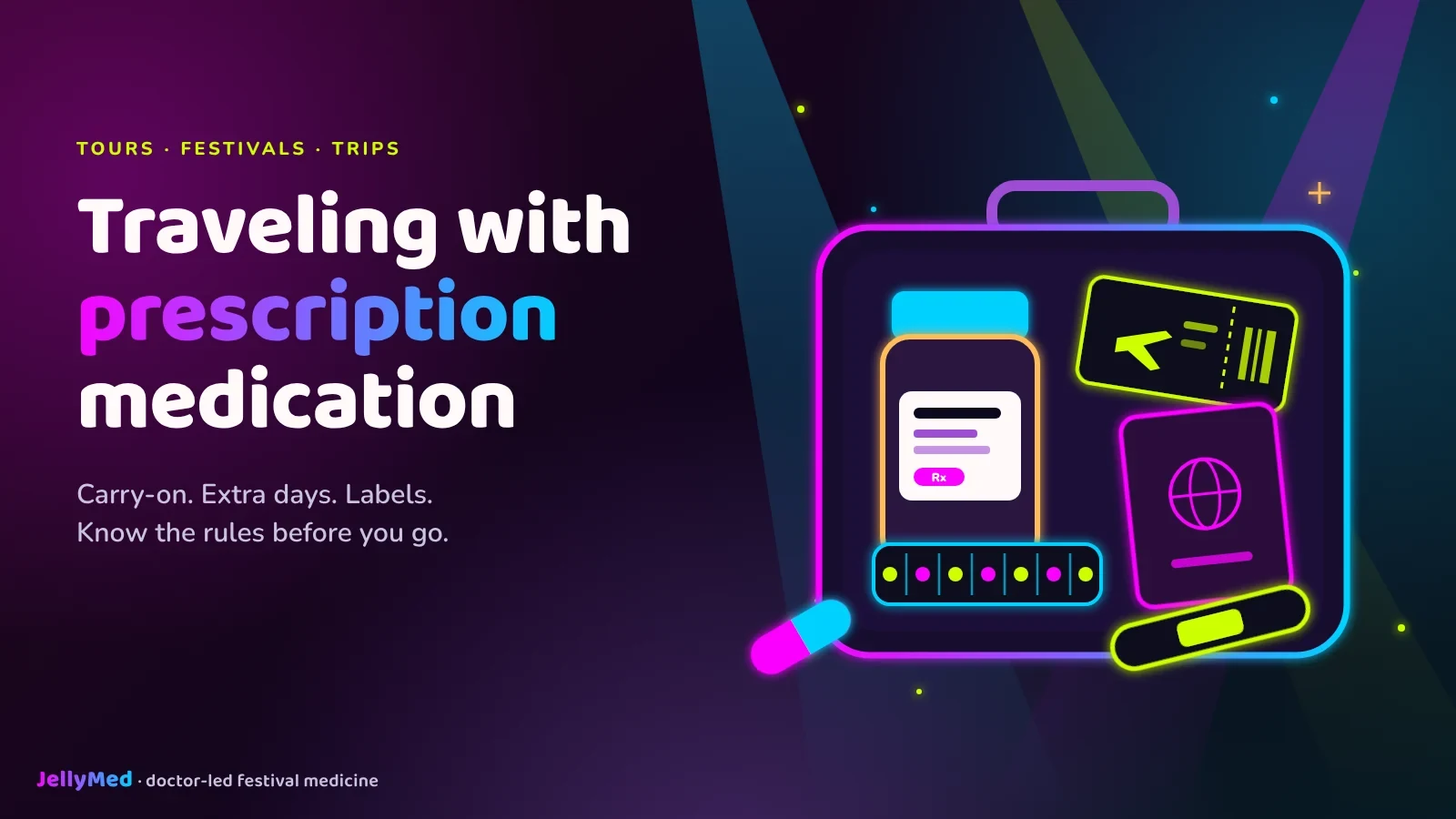
That's the most common way a good trip goes sideways, and it's almost always preventable. Traveling with prescription medication comes down to four habits: keep every dose in your carry-on, pack a few extra days' worth, carry proof of what each medicine is, and check the rules before you cross a border. Do that, and a slow security line or a lost suitcase is just an annoyance, not a medical problem.
Below is the travel checklist we'd hand a friend before a festival weekend, a band tour or two weeks abroad.
Why your medication needs a travel plan
At home, your routine does the work. The pharmacy is ten minutes away, your pills live next to the coffee maker, and you take them at the same time every morning.
Travel removes all of that at once.
Schedules shift by the hour on the road. Checked bags get lost or delayed. A van parked in July sun can heat up far past the storage temperature on your pharmacy label. Fly east or west and your "8 a.m. pill" stops meaning anything. And at an international destination, the medicine you've taken legally for years might need a permit, or be banned outright.
None of this is rare. It's just easy to forget about until you're standing at a counter abroad, trying to explain your prescription with a translation app.
The good news: almost every problem on that list is solved before you leave the house.
The prescription travel checklist at a glance
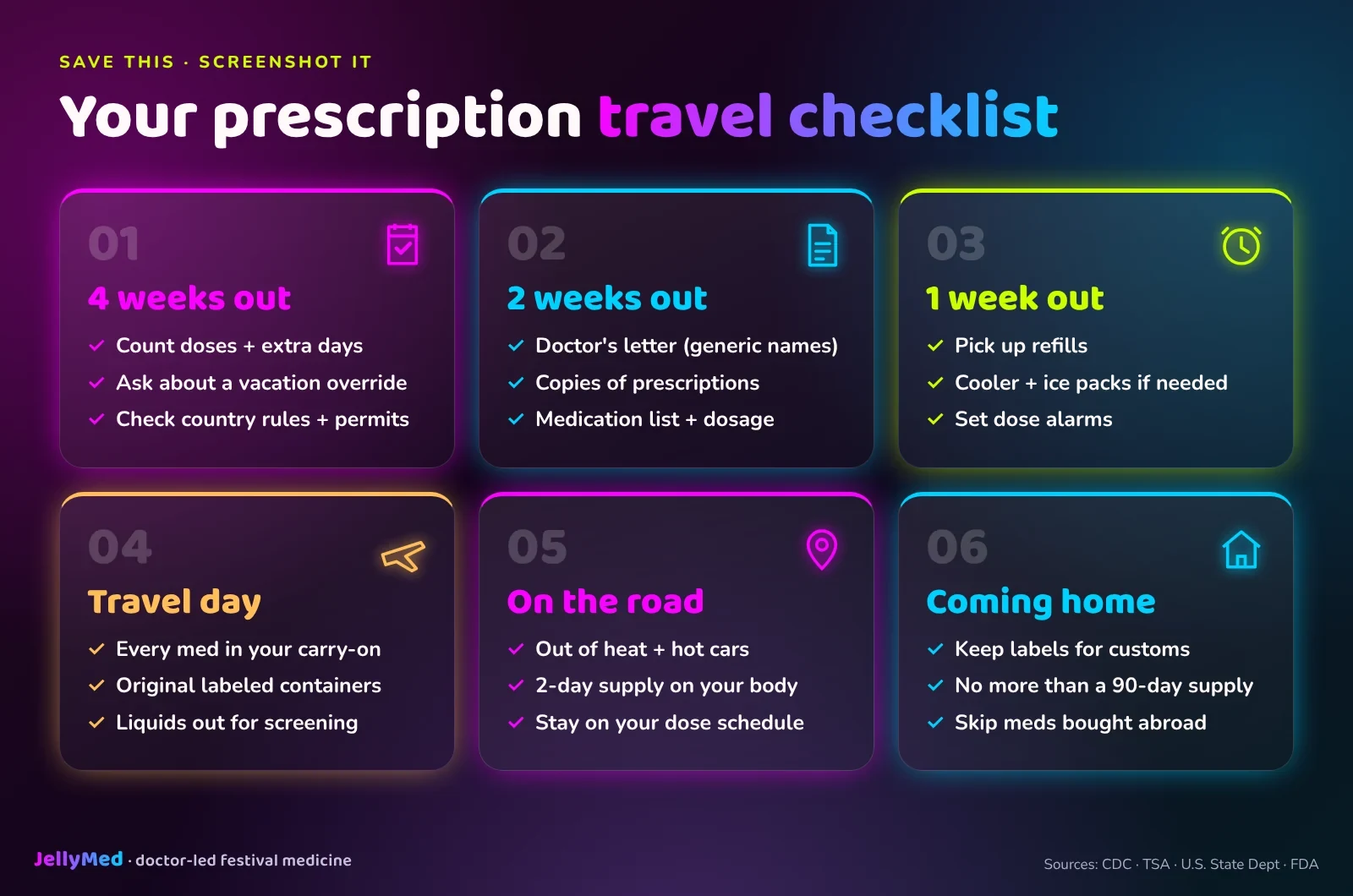
Save this, screenshot it, or print it and tape it inside your suitcase lid. The sections below explain the why behind each step.
| When | What to do |
|---|---|
| 4 weeks out | Count what you need for the whole trip plus extra days. Ask about a refill or vacation override. Check country rules and permits. |
| 2 weeks out | Get a doctor's letter and prescription copies. Write a medication list with dosage. |
| 1 week out | Pick up refills. Buy a small cooler if anything needs refrigeration. Set alarms. |
| Travel day | Pack all medication in your carry-on, in original containers. Set liquid meds aside for security. |
| On the road | Keep meds out of heat. Carry a two-day supply on you. |
| Coming home | Bring back only what you need, with labels intact. |
Four weeks before you go
A month sounds like overkill. It isn't, mostly because refills, insurance approvals and foreign permits all run on someone else's schedule.
Get enough medication, plus a buffer
The CDC recommends bringing enough medicine for your entire trip plus extra in case of travel delays. The State Department puts it as "a few days" of buffer. We'd go with three to five extra days for domestic travel, and a full week for anything international. Pack the over-the-counter basics you rely on, too. Your usual over-the-counter brands can be surprisingly hard to find abroad.
If your refill date lands mid-trip, ask your pharmacist to request a vacation override from your insurance. According to ASHP's SafeMedication, most plans cover a vacation refill at least once per prescription. Give at least a week's notice and have your travel dates handy.
While you're on the phone, ask what's covered away from home. Medicare generally does not cover care outside the U.S., with limited exceptions. Check your plan and any travel medical policy before you leave.
Ask for a doctor's letter and prescription copies
A short doctor's letter on letterhead does a lot of quiet work. Ask your healthcare provider to name your condition, list each prescription by its generic name and dosage, and say why it was prescribed. Generic names matter because brand names change from place to place.
Keep the letter with your medicine in the original containers, and keep a photo of it on your phone. That documentation matters most for injectables, syringes and controlled substances like ADHD medication, opioids and some sleep aids.
Check whether your medicine is legal at your destination
This is the step people skip, and it's the one with the worst outcome. The State Department warns that some medicines legal in the U.S. are illegal elsewhere and could lead to arrest or detention abroad.
Japan is the classic example. The U.S. Embassy in Japan notes that many common U.S. medications and over-the-counter drugs are illegal there, and that bringing more than the approved quantity requires an import certificate (a Yunyu Kakunin-sho) that can take several weeks to process.
Contact the embassy of every stop on your itinerary, layovers included. The CDC adds that many countries allow only a 30-day supply of certain medicines, and your healthcare provider can suggest alternatives if something you take isn't allowed.
How to pack medication for airport security
Good news first: airport security is a lot more relaxed about prescription medication than most people expect.
What TSA allows in your carry-on
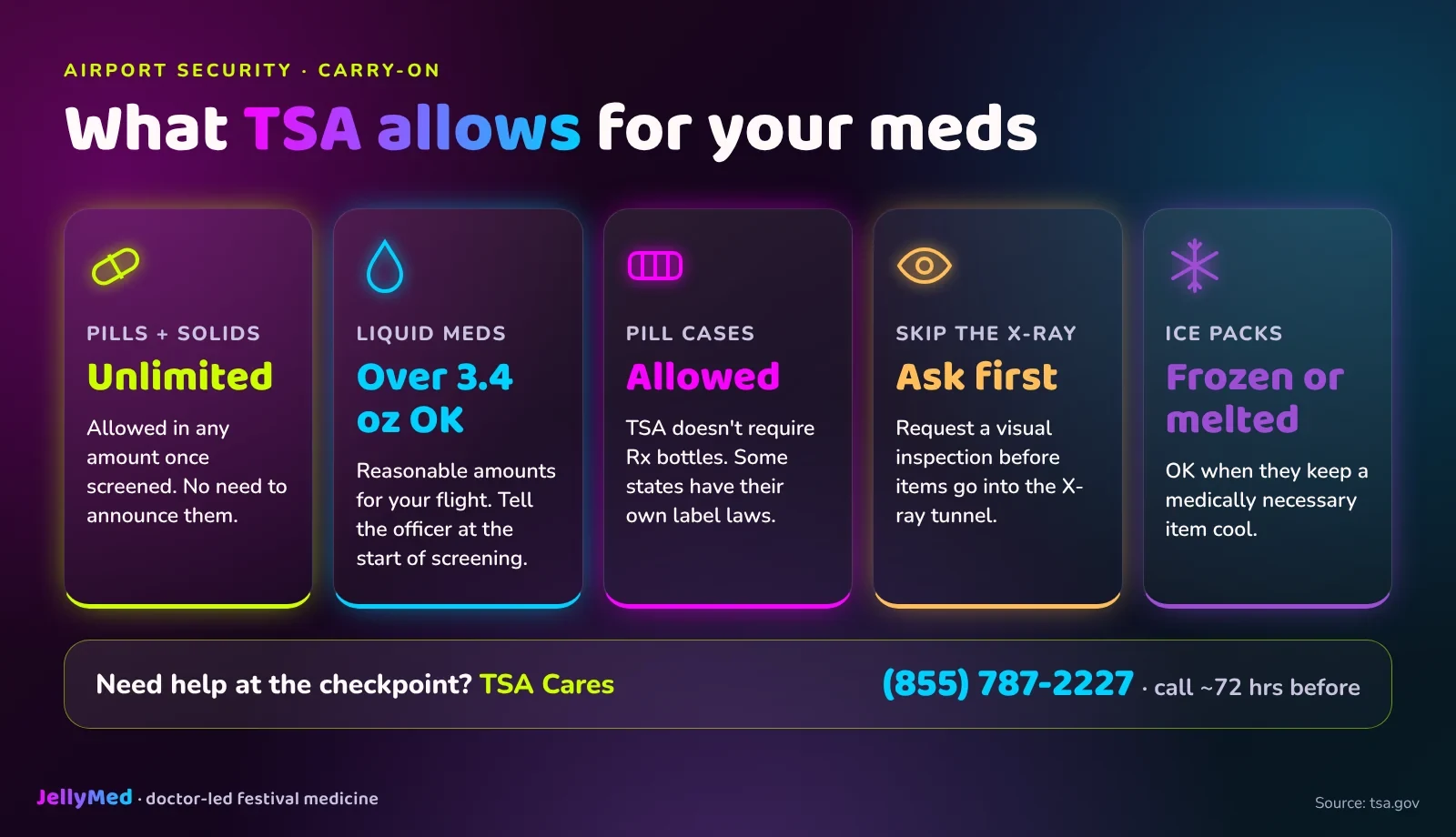
Here's what the TSA says, in plain terms:
Pills and solid medication: allowed in unlimited amounts, as long as they're screened. You don't need to announce them.
Liquid medication: allowed over 3.4 ounces in reasonable quantities for your flight. Tell the officer at the start of screening and take it out of your bag.
Pill organizers: fine at the security checkpoint, since prescription bottles aren't required. Some states do have their own label laws, though.
X-ray worries: you can ask for a visual inspection instead, but ask before your items go into the X-ray tunnel.
Ice packs for medicine: allowed frozen, partly frozen or melted when they keep a medically necessary item cool, per the medical screening page.
Need help in the security line? Call TSA Cares at (855) 787-2227 about 72 hours before your flight.
Our take on the pill case versus bottle debate? Use both. Keep the bottles with their pharmacy label in your carry-on for any customs officer or doctor who asks. Then pack a small pill organizer for daily use so you're not juggling eight bottles on a bus.
Why your meds never go in checked luggage
Lost luggage is the whole reason. Even on a short flight, a checked bag can take days to find you, and on a multi-city run it may never catch up. Checked bags can also sit for a long time on a hot tarmac or in a cold loading area before and after a flight.
Everything that keeps you well goes in the bag that stays with you. That includes inhalers, EpiPens, insulin, glucose supplies and your CPAP machine.
Heat, cold and time zones on the road
Your medicine cares about temperature more than you do.
Temperature-sensitive medication and insulin
Most pills are made for ordinary room temperature, and a parked car or a sunny campsite can blow straight past that. Check the storage line on the label. Then keep medication in the shade, inside your bag, and never in the glove box.
Insulin is the one people ask about most. Storage temperatures and time limits depend on the exact insulin and container, so follow your product label and pharmacist's instructions. The FDA's emergency storage guidance is not a substitute for those instructions. Protect insulin from direct heat and sunlight, keep it from touching ice packs, and never use insulin that has frozen.
If anything you take needs a fridge, call your hotel ahead and ask for one. Most will say yes for medical storage.
Staying on schedule across time zones
For a lot of once-a-day medications, a shift of an hour or two doesn't matter much. For some, it really does: insulin, birth control pills, seizure medication, HIV treatment and PrEP, and some heart medications.
So ask. Before you go, have your healthcare provider or pharmacist tell you whether to stay on home time or shift your schedule gradually during the flight and the first few days after you land. Then set your phone alarms to the dosing schedule you and your clinician agreed on.
Tours, festivals and cruises need a few extra steps
Group travel adds a layer most guides ignore. On a band tour, a festival weekend or a cruise, you're not in charge of the schedule. You might not see your luggage for hours.
A few habits that help:
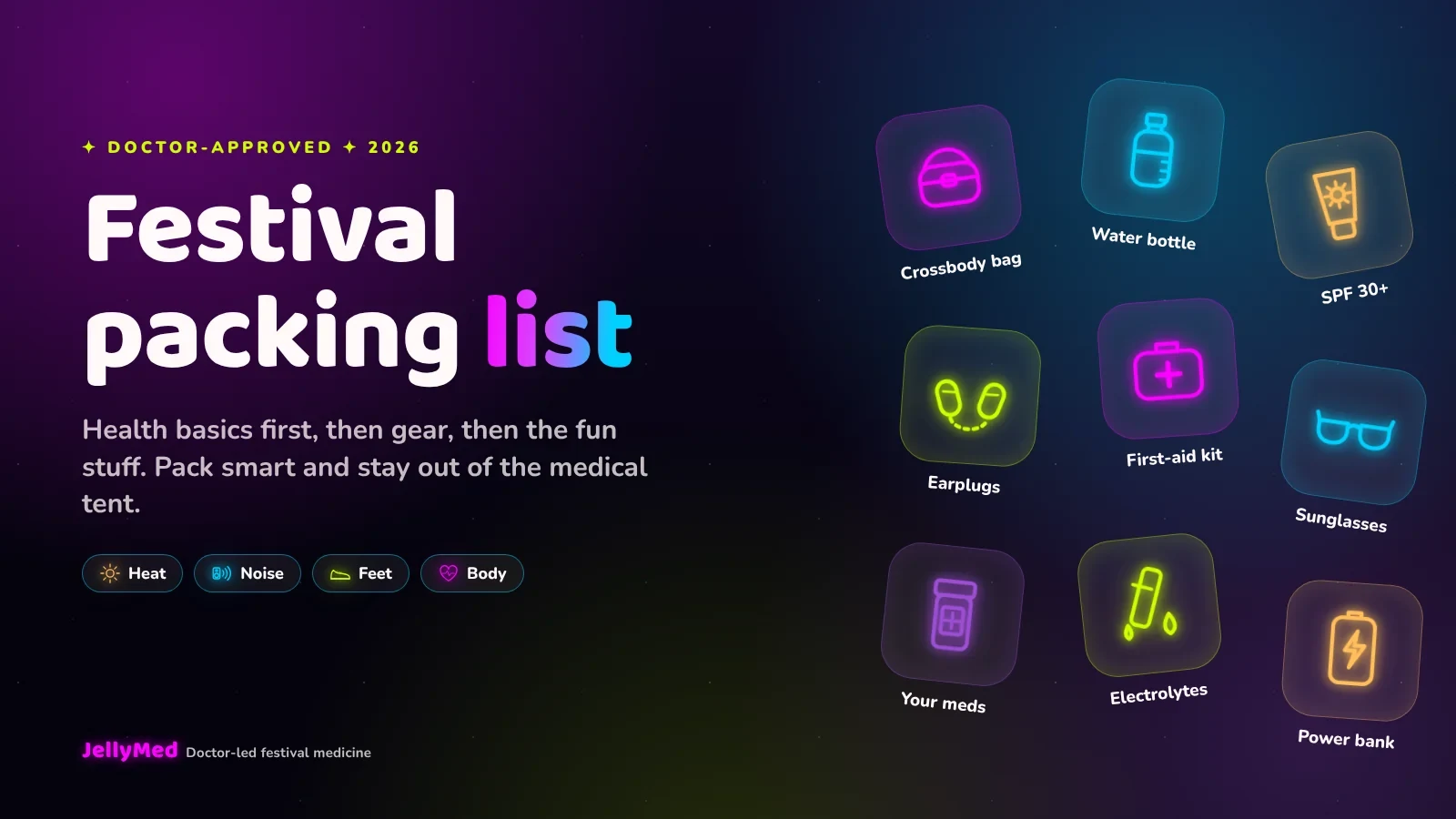
- Carry a two-day supply on your body. A small pouch with a copy of each label, in a fanny pack or jacket pocket, covers you when the bus leaves early or your bag is locked in a trailer.
- Tell one trusted person. Your tour manager or a bandmate should know what you take and where it's kept, especially if you carry an EpiPen or a rescue inhaler.
- Keep a medication list on your lock screen. Generic names, dosage, allergies and an emergency contact. If you can't speak for yourself, medics can still see it.
- Plan around the heat. Festival grounds and cruise decks get hot, and some medicines make you more sensitive to sun or dehydration. Ask your pharmacist if yours is one of them.
At sea, check the rules for each port, since stepping off the ship means entering that country. The ship's medical center helps in a crisis, but it isn't a place to refill your regular prescriptions.
Bringing medication back into the U.S.
The trip home has rules too. The FDA's guidance for bringing medication into the U.S. suggests keeping it in the original container, carrying a prescription or doctor's note in English, and bringing no more than a 90-day supply.
Skip stocking up on cheap medicine abroad. The FDA doesn't permit personal importation of unapproved versions of FDA-approved drugs, and the CDC warns that counterfeit medicine is common in some parts of the world. If you bought anything abroad that you'll keep using, ask your doctor about it at your next visit.
Forgot or lost your meds mid-trip?
Travel mix-ups happen to careful people too. Here's what to do, in order:
- Check how urgent it is. Missing a vitamin is not the same as missing insulin, seizure medication or an inhaler. If a missed dose could turn serious, get in-person care now.
- Call your home pharmacy. Many chains can transfer a prescription to a branch in the city you're in, as long as you're still in the U.S.
- Talk to a clinician. If you need a new prescription, a telehealth visit can be the fastest route.
That's the moment JellyMed was built for. You can start a $45 visit with a licensed clinician by secure chat or video, and choose "Forgot my meds" in the symptom finder. Your clinician reviews what you take and decides what's safe to prescribe remotely. Honest limits: a prescription is never guaranteed, medication costs are separate, and JellyMed doesn't prescribe controlled substances.
When to get in-person or emergency care
Call 911 or go to the nearest ER or on-site medical tent for chest pain, trouble breathing, a seizure, signs of a severe allergic reaction, confusion, or blood sugar you can't bring back into range. Don't wait on a telehealth visit for any of those. JellyMed keeps a list of red-flag symptoms worth bookmarking before any trip.
Questions people ask about traveling with prescription medication
Do prescription medications have to be in original containers when flying?
No, not for TSA, which doesn't require prescription bottles, so a pill organizer is fine at security. Some U.S. states have their own label laws, and many countries expect original containers at customs. The safest setup is labeled bottles in your carry-on plus a pill case for daily use.
Will TSA stop you for prescription medication?
Rarely. Pills and solid medication are allowed in unlimited amounts once screened, and you don't have to declare them. Larger liquid medications are allowed in reasonable quantities, but you need to tell the officer at the start of screening. You can also ask for a visual inspection instead of an X-ray.
Do I need proof of my prescription when traveling?
Within the U.S., usually not, though a pharmacy label helps if anyone asks. For travel abroad, carry copies of your prescriptions and a doctor's note listing each medicine and its dosage. It's especially important for stimulants, opioids, injectables and syringes, and some countries also require a permit before you arrive.
Is it okay to have a Ziploc bag of pills when flying?
For TSA screening, yes. Loose pills in a bag are allowed as long as they go through screening. The risk comes later: an unlabeled bag is hard to explain at a foreign border or to a doctor if you get sick. Keep the original bottles or your prescription copies with you too.
How much medication can I bring on a trip?
Bring enough for the whole trip plus a buffer for delays, which the State Department describes as a few extra days. Some destinations limit certain medicines to a 30-day supply, and the FDA suggests no more than a 90-day supply when you return to the U.S. Check the rules for each stop before a long trip abroad.
Before your next tour or flight, take ten minutes tonight. Count your doses, check your refill date and look up the rules for every stop on your travel plan, then pack your meds first so they can't be forgotten. If something still goes wrong on the road, your joy deserves backup, and JellyMed is there for the non-emergency stuff.